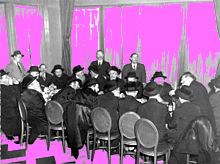
If this were a Chassidic tale, it might begin
with a journey. Maybe a great rabbi in disguise as a pauper, visiting poor
households and offering miraculous blessings. Or perhaps someone traveling to a
great city to arrange a marriage or find a cure or sell an old wagon. And on
the journey there might be an unexpected obstacle – a horse goes lame, a river
floods, or Shabbes falls early.
My story begins with a journey in early August, from Manhattan to Albany, on my way to the foothills of the
Berkshires for Nehirim Camp, a sorta-real, sorta-mock summer camp experience
for gay Jewish men. My accidental seatmate on the train was an Orthodox Jewish guy,
with a tractate of Talmud on his tray table. I asked what he was studying.
“Talmud,” he answered.
“I know, but which volume?”
His eyes darted around nervously. “Niddah,” he whispered. This is the tractate about women’s purity and menstruation. His face reddened. “I never had
the chance to study this when I was young,” he added, looking like he’d been
caught with his hands in his mother’s dresser drawers.
If this were a Chassidic tale, the unexpected
traveling companion would maybe be a supernatural figure, posing as flesh and
blood. Maybe an angel, maybe a demon. And when I get caught up in conversation
with someone who is Orthodox, I confess that I’m open to the angel, but tend to
expect the demon. I expect that as he gets to know me, I will be judged and
condemned, the naked-headed gay guy who talks Torah but drives on Shabbes. I would be his demon.
But I was feeling happy that morning, maybe more
expansive than usual. So I took the risk of conversation, and soon we were, to
my surprise, studying together, not Niddah, which stayed resolutely shut, but a project of mine. An hour in, he asked me where I was heading.
“To a gay Jewish retreat,” I answered.
Ba-bum. Ba-bum. Ba-bum. Our hearts marked time
while our eyes remained riveted to the back of the seats in front of us, the
Hudson Valley flying past the window.
“So you’re gay?” he asked.
“Yup.”
And I braced myself for an as-yet unformulated
unpleasantness. Instead, he dropped his head, sighed and said, “It’s terrible
what happened in Jerusalem last week.” Meaning the murder of a 16-year old girl
by a crazed Orthodox man at the Jerusalem pride parade. I was caught off guard
by his compassion and his sad tone, as if he were apologizing for both the
incident and his own helplessness. My surprise was not unlike the surprise of
so many Chasidim in so many stories, when the rebbe reveals unexpected magical knowledge
of a joy or a tragedy that his disciples had not perceived.
“Yes. Terrible,” I replied. We sat in silence for
some minutes, and then resumed our study.
Eventually I arrived at the Easton Mountain
retreat center in Greenwich (“Green-Witch”) – not Greenwich (“Grennitch”) – New York. And green Greenwich certainly
was. Coming from our thirsty state, the expanses of soft grass and the array of
ponds and lakes seemed immodest almost to the point of vulgarity.
Once there I met the week’s other faculty
members, including a rabbi, a cantor, a yoga guy, a nature-and-creativity guy,
and a porn actor. We reviewed the schedule and got to work. My docket included
teaching a class every day of the retreat, leading the Friday night service, and
holding a late night tish, modeled on
the Rebbe’s Tish of old, where I
would tell stories and lead niggunim.
And then the participants began to roll in. Like
Chasidim would pour into Bratzlav or Berditchev or Lublin, to spend the Jewish
holiday at the shtibl and table of
their favorite rebbe. Instead of Yisroels and Motls and Shmuels, we instead had
Davids and Steves and Marks and Sams – several of each, in fact. Instead of
gabardines and shtreimls we had
shorts and tank tops and, by the pool, nothing at all.
These were guys who had all experienced struggle
and exclusion in the world broadly and in the Jewish world specifically,
because they were gay, and mostly of a certain generation, and they were here
to do some reclaiming of Jewish turf together. Some of them live very active
Jewish lives; some were returning to Judaism after long absences. Many had been
instrumental in forming gay synagogues on the east coast, where they defiantly re-created
the more conservative observance of their childhoods. And so I was struck at
how in a group of 50 Jewish gay men, I still felt at the fringe in terms of Jewish
ritual and Jewish thinking. Although I am pleased to note that I was not the
only one who spent Shabbes in a skirt.
I co-led Kabbalat
Shabbat with an old friend who is now a cantor and composer. As soon as I
began speaking I became aware that how I do it, commonplace for us here at Ner
Shalom, was completely new for most of them. I could see their surprise at the
visualizations, and the punch lines, and the sexy talk, and the use of Cole
Porter’s “Night and Day” as our Ma’ariv Aravim
prayer. I was afraid my methods might
provoke resistance. Instead, hearts seemed to open up and the night got higher
and higher.
And it kept getting higher and higher. After Shabbes dinner we settled in for the tish. For an hour or more, in a small
room of dinner tables and folding chairs, we sang niggunim and I told stories, two from the Chassidic world and one from
the trusty Chelm repertoire. One of the two Chassidic stories was about women. There
are not as many of those stories, but they do exist. They are usually about rebbetzins, the wives of well-known rebbes. They typically have to do with
either her generosity or her cooking, both of which are taken in this
literature as expressions of piety and closeness to God, and are set out as an
example for women and men alike. Beautiful, sweet, non-revolutionary stories.
I brought a rebbetzin
story in because in this male-only space, in this somewhat but not completely
tongue-in-cheek reenactment of a Chassidic court, I was beginning to feel uncomfortable
in my chair and in my body.
I confess that I love the ecstatic singing and
storytelling of the Chasidim. And as a man (well, as a man who can pass as
straight) (well, as a man who can pass as straight with some considerable effort), loving that stuff is a privilege I have access
too. But in my non-nostalgic waking life, it’s not so easy. I am not able or
willing to pray or celebrate somewhere in which women are kept out of
leadership and out of the room; in which women’s voices are considered treyf, and in which my life and my
family would be considered treyf also
if anyone bothered to ask about it. So I
no longer pray with Chabad, for instance, no matter how good a party they
throw, and no matter how much I need to say kaddish.
And while it’s fine for the men and women who opt for that life to do what works for them, my participation in it would be, for me, hypocritical.
And caught between these two truths, that
sometimes men-only space might be healing and sometimes it might be a danger sign, there
we were, a room full of men, just men, singing.
And the singing was celestial. Because these
were not just random Jewish men. These were four dozen gay Jewish men. “Artsy” men, as so many of us had been referred to
euphemistically by our great aunts. Some of them were fine professional musicians;
some were vocally trained. I’d guess 80% of them had been in all their high
school musicals, and a good number of those have kept their chops up at piano
bars up and down the eastern seaboard. These guys could sing. And they could
harmonize. And the walls of the room trembled with the splendor of it. They
were a heavenly choir of first and second tenors, baritones and basses.
Melodies poured out; tables were pounded. And I couldn’t help but have the
overwhelming sense that we were some European yeshivah, or some lively rabbinic court, the way they are described
in the stories.
Now if this were a Chassidic story, there would now
be a twist. The triumph of some underdog. God accepting the prayer of an
outcast over the objection of the rebbe’s disciples. Or maybe the Prophet
Elijah would be revealed at a key moment, in the form of a beggar at the door,
and the behavior of the characters would be evaluated in a different light. I
awaited the twist, the tikkun.
We sat and sang and the room rocked, and it felt
impossible that fewer than 50 men could make music this big. And I suddenly had
a vision of other souls fluttering into the room. Yeshivah bokhers of centuries past. The ones who spent their youths
in love with their study partners. For whom the subtext of love was supplanted
by the text of Talmud. For whom desire was requited only by debate. The ones
for whom there was no path of fulfillment that included both spirit and body,
and who did the best they could to play the roles expected of them, riddled
though they might have been by despair. Or for whom, perhaps, it was enough,
but for whom today, it would not be.
I felt these souls fluttering into the room to
join us, a trace of worn leather and musty books in the air. I felt them taking
their places on the few empty folding chairs; or perching on tables or
shoulders or the very rafters. I imagined I heard their voices singing out as loudly as we
were singing. And we, who had struggled to reclaim a piece of Judaism, had managed to create, for a moment, a safe place for them.
I’m not sure anyone saw this other than me,
although it might be that everyone did. But in that moment, the voices of the
yoga guy and the porn guy and the nature guy, the voices of men in pastel polos
and men in white Shabbes shirts and men in skirts too, rose up, with the counterpoint
of skilled musicians and a cry of deep longing, eventually causing the roof
to crack right open, and, carrying an unspoken prayer for a more loving world, the
music of all these men flew up, like a pillar of flame, straight to heaven.
Sending much gratitude to Nehirim, Rabbi David Dunn Bauer and all the wonderful men who staffed and attended Nehirim Camp this year.
Sending much gratitude to Nehirim, Rabbi David Dunn Bauer and all the wonderful men who staffed and attended Nehirim Camp this year.


