Friday, August 19, 2011

Ekev: Bread, Spirit and Hard Times

[For Congregation Ner Shalom, August 19, 2011]


Man does not live by bread alone.

Pop quiz time: where does this old, over-familiar chestnut come from? Anyone know?

It's from this week's parashah, called Ekev, from the Book of Deuteronomy. To recap: Moshe is making his farewell speech, which is really the whole Book of Deuteronomy anyway, and he is reminding the Children of Israel of their wanderings in the desert, their covenant with God and the obligations attendant thereto. Moshe reminds the people that God offers blessings in return for keeping mitzvot and some dire consequences for not.

And most of the rewards and punishments are repeatedly drawn in terms of food.

We are told that if we hold up our end of the bargain with God, we will have grain and wine and plenty of dairy products from happy cows. We are told that our lives in the Promised Land will be marked by abundance of wheat and barley and, as tomorrow's Bat Mitzvah pointed out to me, "just like in Sonoma County," vines and figs and pomegranates and olive oil and honey.

Even the Children of Israel's impending conquest of the Canaanite territory is described in shockingly gastronomic terms:

ואכלת את כל העמים אשר יי אלהיך נתן לך
v'achalta et-kol-ha'amim asher Adonai Eloheycha noten lach.
 
"You shall eat all the nations that Adonai gives you."

Some later commentators backed off this vivid and violent image by re-reading the sentence not as "you shall eat all the nations" but rather "you shall eat with all the nations," supportable in the Hebrew and reflecting a very, very different vision of a Promised Land. But still with "eating" as the central measure of our success as a people.

So why is food so potent a metaphor? Not that many haven't already theorized on this ad nauseum. But now it's my turn.

Looking within the text, we see that the Children of Israel were nomads. Pre-agricultural. Crop-free. Their diet, like the landscape, was without variety. Without softness or sweetness or abundance or certainty. It was made up of manna - heaven's crumbs. The idea that the Children of Israel could survive for 40 years on the monotony of manna was so inconceivable to later thinkers, that midrash had to attribute to the manna magical qualities. Legend therefore says that manna could taste like whatever the eater most craved. Sort of the "Bertie Bott's Every-Flavour Beans" of the Biblical imagination. But in the p'shat, in the text itself, it wasn't every flavor. It was just crumbs.

And so undoubtedly the Israelites lived inside a certain anxiety about food. Subsistence was always in question and they were helpless to change that. In an odd way, we are, most of us, similarly helpless in the world of food. We are post-agricultural. We have access to variety, to the sweet and savory and colorful and exotic. But we've mostly lost the ability to fend for ourselves; we mostly don't have our own gardens; we mostly don't keep bees. If disaster kept food from our grocery stores long enough, what would any of us do then? (Just thought I'd ask in case you weren't feeling anxious enough.)

Food represents desire for ease but also deep fear about survival. And in this era and economy where we don't grow it, we've shifted our fear of starvation from food to that which entitles us to it: money. Which we still call bread. Or dough. Even our wages are called our salt, our salary. We fear financial loss because money, which we do not eat, has nonetheless become conflated with survival. As markets lurch and drop, so do our stomachs.
 
So here's where Torah steps in, with the quote we began with. One does not live on bread alone. Torah does not dispute the necessity of bread, but takes issue with it being the sole element upon which our survival hangs. The full quote is this:

ויענך וירעבך ויאכלך את המן אשר לא ידעת ולא ידעו אבתיך למען הודיעך
לא על הלחם לבד יחיה האדם כי על כל מוצא פי יי יחיה האדם
Vay'ancha vyar'ivcha vaya'achilcha et-haman asher lo yada'ta 
v'lo yad'u avoteycha lma'an hodi'acha lo al-halechem l'vad 
yich'yeh ha'adam ki al-kol-motza' fi-Adonai yich'yeh ha'adam.

"Adonai humbled you, and let you hunger, and fed you with manna, which you'd never seen and neither had your ancestors; so that Adonai might make you understand that you do not live by bread only, but you live by every word that proceeds out of Adonai's mouth."

For some, bread feeds the body and baking it feeds the spirit.*

The Israelites' hunger was a test - a terrible test, intended to teach a lesson - that survival involves two elements. The earthly and the divine; the physical and the metaphysical, bread and spirit. Survival requires both. And even when we face deprivation in this tangible, bankable, edible realm, we still can experience abundance in the realm of the spirit. Our bread may be finite, but what pours forth from Adonai's mouth is not.

And what does pour forth from Adonai's mouth, from Adonai's word? The answer, in our tradition, is: everything. Creation is God's word. Light and dark. Sea and sky. All that is green. All that breathes. All that walks on two legs and the loving communities that we bipeds have created. Wisdom, beauty, delight, compassion, courage. These are all dynamics in the song of Creation. Even when we're not certain that there is a Creator, we have no similar doubts about these qualities.

We need these to live. We need these to support us when we wander in the wilderness, with only crumbs to eat.

I've been thinking about this lately because I've been watching so many people in our community and in my circle of friends face unprecedented challenges and hardships. This is a tough time right now by anyone's standards. But in addition to that: people we all know are losing their businesses. Their jobs. Their homes. Terrible. People are losing reliance on their bodies. Terrible, terrible stuff to face.

And I've watched some people experience these challenges as if it were the utter collapse of their lives. I don't mean to minimize suffering. Suffering is all-consuming. It is in the nature of suffering to be so.

But, Torah says, you do not just live in this physical world. You have dual citizenship. You are part spirit as well. And that piece is half of what sustains you.

The hard stuff that happens is not the collapse of life. It is trouble. Just trouble. It will pass. Or it will be accommodated. Or adjusted to. There might be loss - there will be loss; we will all experience loss. The trouble might cost money. It might mean a new way of living or of being. But it is not the collapse of life, not its disintegration or its unraveling. It is not a referendum on how you live. It is not a punishment. It is trouble. Just trouble. It is not something you deserve. It is not something anyone deserves. It is trouble. Just trouble. In Yiddish we call it tzoris, and it sounds warmer, more domestic, a piece of ungainly furniture awkwardly placed in your house so that it must be walked around. Tzoris. Hard times. Trouble.

So when you count what you have, what sustains you, what arms you against the trouble, you must count more than your bread. More than your money. More than your limbs. You must count all your resources - your humor, your smarts, your compassion. Your love of music or prayer or study. Your love of that smell of fennel in West County or the deep rumble of your cat's purr. You must count your people. Friends if you have them. Loved ones. Family. Even the noodgy family. This holy community. All these things are riches no less than money. They are all in your treasury. But you have to be willing to count them. And use them. Accept help. Accept love. Impose on others when you need to. And let yourself be imposed on down the road.

Keep feeding not just your body but your spirit. And then when you come out on the other end of this trouble you will still be you. You with less money. You with a different home. You with different physical limitations. But still you.

Can we survive hardship? Yes. We can. We can endure. The quality of endurance, of netzach, is in us. We will outlive the trouble and we will turn back and sing in Stephen Foster's words:

Hard times, hard times, come again no more.
Many days you have lingered around my cabin door.

There's one final quotable in this week's Torah portion that I want to share. Also about food and sustenance:
ואכלת ושבעת וברכת את יי אלהיך
V'achalta v'sava'ta uverachta et Adonai Eloheycha

You shall eat and you shall be satisfied, and you shall bless Adonai. What does this mean? We shall eat until we are satisfied? The verse doesn't say that. You shall eat. And you shall be satisfied. These are separate commandments, separate instructions, separate hopes. We must feed our bodies and pay our dues to this physical realm. But fulfillment, satisfaction, that is a quality of the spirit and we are reminded to strive for that as well.

We endure by having a foot in each of two realms. We endure by sustaining ourselves in both. Ozi v'zimrat Yah, we say in the Book of Exodus, vay'hi li lishua. My strength combined with the Divine music together are my salvation. And maybe that is the secret of endurance: remembering and trusting that there is more to me than this bag of bones. And that "more" is testified to in all of Creation. As our friend Sally Churgel wrote in a haiku just yesterday morning:

Trust that you are held
After all, the sun rises
each day in glory

May we have bread. And may we find satisfaction. And may the sun rise each day in glory.

And let us say, Amen.


* Bread by Zohar Kochavi; Photo by Ilan Schlossberg
---------------------------------
If you are looking for a spot for High Holy Days this year, consider Ner Shalom in Cotati, California. Find out more by clicking here.

Friday, July 15, 2011

Parashat Pinchas - Disillusionment and Demand

Notes from the Holy Land, Part 2.
Click here to see Part 1.


It was a long climb this morning from the Dead Sea plain up to the summit of Masada. I started ambitiously, passing other groups, trying to demonstrate a brisk pace to the 14-year old. But somewhat later, drenched in sweat and plodding up the Snake Path — step, gasp, step, gasp — it dawned on me that the last time I climbed Masada I was 28. I also did it at 19 and at 16. Now - step - I'm - gasp - 50 - step, gasp. It dawned on me that this would be the last time I'd attempt this. I smiled to myself, despite my body's desire to curl up in a ball right there on the spot. And while (who knows?) if my body remains compliant and the opportunity arises I might not in fact hold to that resolve, I felt a small surge of pleasure. Being here at 50, trying to climb as if I were 20, and not failing completely, I felt like I'd at last earned my future cable car rights.

Climbing, one would pass other groups and later be passed by the same ones, as our comparative levels of fatigue and suffering leapfrogged their way up the mountain. One group of Israeli teens got separated into two with considerable distance between them, and took up the habit of shouting down (or up) to each other, while those of us for whom pre-dawn hikes in the Holy Land have a certain mythic quality winced at the noise and got jarred out of our meditative states. "Geez," I couldn't help thinking, impatient with their loud excitement, "why can't they just use their cell phones like everyone else?" Which shows, I suppose, how hardened one becomes after just two weeks here.

The truth is, there is nothing as disillusioning as a trip to Israel. When I return home, it takes months — no, years — for my romanticism to re-accrete on the skin of my sense of Israel. Like many Americans, like many Jews, I go to Israel seeking. Not seeking anything specific, but seeking some validation of who I am as a Jew. At home I engage in personal and community ritual in which the name of this land and its people of old are uttered again and again and again. I breathe Israel in and out. I imagine it and it grows beautiful. So I imagine it to love me back. But then, in the same way that upon a lover's return after a long absence their face is somehow not exactly as you remembered it, a visit to Israel brings on a certain reckoning and re-recognition.

This always involves loss. For instance, I am forced to acknowledge that who I am as a Jew, how I relate to Judaism, how I practice my Judaism, how I hold the idea of Israel, are all part of a spiritual worldview that is born in America, and bound to its soil and its air and its peculiar dream of liberty and individualism. I think about how I (and we) am (are) constantly at play with our tradition, turning it over lightly and carefully, searching for the intent that feels true, and then, at our best, re-shaping our actions to carry that intent forward in vibrant, creative ways. We do it without rabbinic rulings. We do it with a limited 21st Century American Jewish literacy. What we do would be met in Israel alternately with "no!" and "huh?" and "but why?"

Who I am as a Jew is almost never reflected back at me when I'm in Israel.

But I think it is worth resisting the temptation to feel dispossessed. Judaism is our inheritance too; it is there for us to claim. And in this matter, I feel spurred forward by the heroes of this week's Torah portion, Parashat Pinchas. The parashah contains the unforgettable story of the daughters of Tzelafchad. Their father had died and they had no brothers; this in a culture in which inheritance passed exclusively through the male line. There was no law given at Sinai to address this situation. So the daughters of Tzelafchad sued. Unlike the daughters of Walmart, they got certified for a class action suit and worked their way to the nation's highest  authority: God. They won their suit, albeit with some limitations. But their willingness to claim — to demand — what was theirs in the name of justice, in the name of authenticity, was noteworthy enough to grab the attention of the Holy One and correct an inequity that was handed down at Mt. Sinai.

I love that even before the Five Books of Moses have run their course, torah misinai — the divine law — is already emended. And so this is perhaps what we have to learn from the daughters of Tzelafchad — Machlah, Noah, Choglah, Milkah, and Tirtzah. Holding and owning our Jewish spiritual and moral presence earns us our inheritance. We might not be feeding into the single great future of the Jewish people that we have dreamed or imagined, but are instead creating one of the many authentic Jewish futures that lie ahead.

I'm down with that. While it would be awfully nice to be reflected back by all Jews, in Israel and in the Great World, we won't be and we don't need to be. In moving forward with integrity and authenticity in our Jewish lives, we are demanding our inheritance — and Sinai is being rewritten in our names.

We do not need to be loved by the Orthodox men who rule the "mays" and "may nots" at the Western Wall. Nor do we need to justify our love of Jewish ritual and spirit to the Israeli secular world. The inheritance is ours as much as it is theirs. No apologies needed, and 'nuf said.

As I huffed and puffed and kricht up the Snake Path this morning, I turned once to my husband and said, "I'm sorry I'm not at my best today." He looked at me, almost surprised. "But you are at your best. You're climbing Masada. What could be better?"

Friday, July 8, 2011

Parashat Balak - a Tale of Two Cities

Notes from the Holy Land.


This week in Torah we read the story of Balaam and his donkey. Recap: he is the seer hired by Balak, king of Moab, to curse the encampment of Israelites crowding the Moabite outskirts. Balaam reluctantly takes the gig, promising to prophesy at the border but with no guarantee of the prophecy's content. Still, his journey is born of the king's wish to do harm and God, acting through angels, interferes with Balaam's progress. His she-ass is thrown off track, and he strikes her, at which point she famously opens her mouth and defends herself in human speech against her rider's maledictions.

So I'm feeling like Balaam a bit. I am back on Israeli shores, an outsider, though not completely so. I am awaiting what my judgment will be, because everyone who visits here is expected to pass judgment. Many Israelis and American Jews would like us to pronounce the place beautiful and redeeming. The Left in America, including the Jewish left, would like to hear our condemnation of Israeli policies. I observe and fear to open my mouth, lest I make an ass out of myself.

Shabbat is drawing close and I am in Tel Aviv, a concrete and steel-sheathed modern city offering a nearly Viennese gemütlichkeit to its population. Cafés and boutiques abound; you have to look hard now to notice the stone memorials listing the names of coffee-sippers of ten or fifteen years ago, blown up with the cafés that hosted them. In the years since, the people of Tel Aviv have persevered. They've endured explosions and sealed rooms and assassinations. A slice of cake and a cappuccino is, for them, not devoid of a certain defiance. They have become more cosmopolitan and, arguably, more snobbish. While their view of most of Israel is not dissimilar to that of a San Franciscan pondering Riverside, their view of Jerusalem contains a particular venom.

For them, Jerusalem has ceased being Israel altogether. While Tel Aviv seems a logical outcome of the Zionist experiment - a bit of fin de siecle Europe rooted and flourishing in sandy soil - Jerusalem is inexplicable. From the start Jerusalem was a city weighed down by history. Every emperor wanted to conquer it, and nearly every emperor did. Jerusalem continues to suffer from an overburden of symbolism. Besides being a holy city for three powerful religions (or two powerful religions and one that perhaps just likes to act that way) it has for millenia signaled ultimate hope: of return, of salvation, of Messianic bliss. No earthly place can or should have to fulfill this level of religious promise.

But it is this very promise that draws so many of us - the curious, the seeker, the Chasid, the Jewish Renewal hippy tourist, the fundamentalist Christian rapturist. Still, despite the wide variety of its petitioners, Jerusalem has chosen its favored child, increasingly nurturing a fiercely non-pluralistic religious population that grows faster than any other segment of Israeli society. The city spreads outward to house its acolytes and devotees, overtaking land that isn't now and wasn't ever empty, pushing Palestinian villagers and farmers and academics and activists back behind a meandering and impenetrable green iron ribbon of fence.

The people of Tel Aviv fear Jerusalem and what it has come to represent. They fear the impending theocracy that has already produced a Jewish state in which marriages and conversions conducted by Reform rabbis are of no legal worth; in which women can't carry a Torah or wear a tallit at our people's holiest site. The Tel Aviv crowd resembles us - they are 1.5-child families. They foresee being overtaken by the religious within 20 years, and you can hear in the back of their minds the click-click of their escape plans forming. The people of Jerusalem long for Jerusalem even now, the long longing of our people. The people of Tel Aviv apply for EU passports.

I had my first view of Jerusalem in seven years yesterday. I'd studied there in my youth and it remains beloved to me. But now I am 30 years older and so is the State that claims it. I stood on the new tayelet - the scenic overlook - in the Talpiot neighborhood, from which I could see the Old City and the Dome of the Rock on my left, and the immense security fence on my right. I had to explain it to the 14-year old I'd brought with me from America, who himself pointed out the repetition of walls in this particular view - a Herodian wall, an Ottoman wall, and now this newest one. I realized that while the Western Wall might for many of us still symbolize longing and hope, the security wall is hopelessness made concrete. It is despair; a great Israeli shrug of the shoulders. A fatigued decision not to solve a problem but to wall it out of existence.

I stood on that height and felt a bit like Balaam, wanting to open my mouth but in the dark about what would come out. Mah tovu ohalecha, said Balaam when his time came. "How good are your tents, O Jacob; your dwelling places, O Israel."

I see the tents too. They are beautiful and they are ugly and then they are beautiful again. The sky is rosy gold, the air warm and dusty, smelling of rosemary and sweat. Shabbat falls. I feel underneath my sadness a deep hope for peace, for rest, even for just one day. I breathe it in deeply - through my nose, letting my mouth stay, for the time being, shut.

Saturday, June 18, 2011

"Rachav, Rachav" - Prostitute, Proselyte, Prophet

For Congregation Ner Shalom - 
June 17, 2011

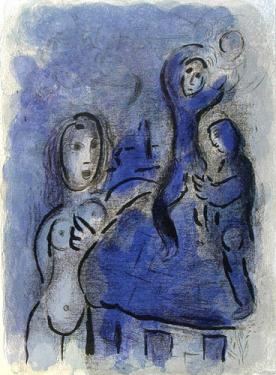
Rahab and the Spies by Marc Chagall
So there I was thinking about what to talk about this week. Our Torah portion is Shlach Lecha, in which the Israelites send a dozen spies into the Promised Land, 83.3% of whom come to believe that the Canaanites are too mighty for them to conquer; that they are as giants to the Israelites' grasshoppers.

Last year I talked about this whole grasshopper thing in connection with the Israeli attack on a flotilla of activists heading to Gaza. Then last Sunday I again drashed this grasshopper story for the Sonoma Pride Interfaith Service, connecting it to the ongoing struggle for LGBTQ rights.

I have gotten so much mileage out of these grasshoppers! And looking toward tonight, I couldn't bear to exploit the little critters yet again. Let them have shabbat off to do whatever grasshoppers do on shabbat, without the heavy burden of symbolism.

So I needed a fresh view. And, well, that's what haftarah is for. So I took a peek at this week's reading: Chapter 2 of the Book of Joshua.

And that's where I first saw her. Our eyes met across the ages and the pages. And I fell in love. Rachav: the prostitute, the proselyte, the prophet.

How had we never met? I'm sure I've heard or seen her name somewhere, but I'd never gotten around to reading her story. And it is a good one. Almost cinematic in its physical intrigue - men hidden on rooftops and climbing out of windows on ropes. I will tell you the whole story and at least try to draw some meaning from it.

It takes place 40 years after this week's Torah portion. The Children of Israel have wandered for four decades in the Wilderness. The slave generation, with just a couple exceptions, has died off. Moses is gone too, succeeded now by Joshua ben Nun, who talks with God with some frequency and who, like his predecessor, can also engineer a parting of the waters when necessary, albeit with the less daunting flow of the Jordan.

The Children of Israel are ready to cross over the river and take the Promised Land. Once again, spies are dispatched — only two of them this time, sent to scout out the City of Jericho. And they come first thing to the house of a zonah, a prostitute, named Rachav, and they "lodge" there, say the translations, although more literally vayishk'vu would mean that they "lay" there, which in Biblical Hebrew is not unlike saying they "got laid" there. So yes, opening scene, two Israelite guys sent on a mission, hit the big city for the first time, and their first stop is the brothel.

Meanwhile the king of Jericho is tipped off that some Israelite spies have found their way to Rachav's house. He sends messengers demanding they be turned over. But she tells them the men left the city gates before nightfall, and if the messengers are quick, they might still be able to catch up with them.

She takes the men and they go gaga. Here I don't mean gaga crazy and I don't mean Gaga the pop diva, but rather hagagah - she takes them "up to the roof." There she hides them under a pile of flax stalks, it being, apparently, flax season, and flax being a source of fibre for rope making, which is about to be relevant. There she confides to them that the men of Jericho are certain they will be Israel's next conquest. Whether she is conveying common knowledge or pillowtalk to which she is especially privy, we don't know. But, she tells them, the citizenry has heard about the Parting of the Red Sea and the people's hearts have melted with terror because, as she says:

כי יי אלהיכם הוא אלהים בשמים ממעל ועל הארץ מתחת

Ki Adonai Eloheychem hu Elohim 
bashamayim mim'al v'al ha'aretz mitachat.

"Because Yah, your God, is God in heaven above and on the earth below." (Words we still sing in the Aleynu prayer.)

Rachav offers to help the scouts escape on the condition that when the invasion comes her family be spared. They agree, instructing her to keep her family in her house and to hang in the window a tikvat chut hashani - a cord of crimson thread - so their forces will know which house to spare. She then lowers a rope out her window and the spies climb down and escape... And sure enough, four chapters later, when the conquest comes and the City is laid waste, Rachav and her parents, siblings, nieces and nephews are left alive.

I think Rachav is a fascinating character. She has a pivotal role in the plot, providing crucial intelligence. And she has a literary role too, providing a tikkun - a kind of reversal of the disastrous scouting trip of the previous generation. Instead of leading the Israelites to believe that their success was untenable, she convinces them it is, in fact, inevitable.

She is also complicated. She engages in treasonous conduct seemingly without qualm, lying to her king's messengers and throwing in her lot with her people's enemy. Yet our tradition doesn't treat her as a traitor, but rather as a proselyte. Someone who acts out of love and fear of our God. our Israelite God. And that makes her, in rabbinic eyes, a hero.

I also like the text's disinclination to dance around her profession. While some of the sages try to recast her as an innkeeper, most don't. She is a woman who has, as the Marxists would say, taken charge of the means of production. And she holds obvious importance in her community;  enough so that the king's messengers don't storm her house but rather knock on her door, wait for an answer, and believe it. She is unapologetic. She is willing to make deals to protect her family's safety. And whatever position she might make her money in, she thinks on her feet.

The rabbis of the Talmud can't get enough of her; in fact, those bookish men in their musty academies seem just a little over-stimulated by her. One midrash says that Rachav was so completely alluring that a man need only say her name twice - Rachav, Rachav - and he will ejaculate. (Yes, it's right there in Talmud.) Rabbi Nachman (the Talmudic one, not the Chasidic one) objects that he said her name twice and that it didn't happen. Rabbi Yitzchak responds that the phenomenon only applies to those who had actually ever seen her face to face, which was undoubtedly politer than saying, "What are you? Gay?"

The rabbis' excuse for obsessing about Rachav is that she is a person of exceptional virtue. She is a model convert, even more sincere and heralded than Yitro or Ruth. Her acknowledgment that Adonai is God in heaven above and on earth below are her words of conversion, revealing her desire to cleave to the God of Israel, a desire present, say the sages, since she heard rumor of the Crossing of the Red Sea when she was a girl. She becomes a Jew and, according to legend, is later married to Joshua, becoming the foremother of many prophets, among them Jeremiah and Chuldah, one of the several female prophets mentioned in Tanakh.

What's more, the rabbis happily point out that in her new faith she forswears being a prostitute. They say this undoubtedly for two reason: (1) to demonstrate the redeeming nature of Adonai; and (2) to have another opportunity to say the word "prostitute." Of course, forswearing being a prostitute might not be so remarkable; according to midrash she'd been in this profession for 40 years already. And as any dancer or athlete can tell you, when you work in a physically strenuous job, you do need to have a retirement plan.

But what is Rachav's symbolic value to the story and to us? Her name, Rachav, means "wide" or "expansive." And while I don't discount the possibility of this being a sexual joke right in the text, I think there's another way of looking at it. She, Rachav, is the first person we meet in the Promised Land. The "expansiveness" suggested by her name stands in contrast to Mitzrayim - the narrow place the Hebrews escaped from. A hint that some important transformation has taken place. The Children of Israel were not the same as they'd been 40 years earlier; the world was no longer the same. Where all had seemed too narrow even for breath, the horizon had now opened up. Everything was possible.

And Rachav seems to symbolize change. Change was in the air. The Children of Israel were about to come into their own. And in Jericho, regime change was about to take place. Rachav, called a prophet in her own right, foresaw all of it and she acted. Unlike so many of us, who follow our human nature and await change with fear or with denial. She looked ahead and took action in the name of her own survival and that of her loved ones. Maybe she is a reminder that action is available to us; that the shockwave of change might be beyond our control, but how we surf that wave is not. Rachav challenges us. Are we looking ahead with earnestness? Are we taking action on behalf of our own survival? Do we have what it takes to save the planet? To save our people? To save ourselves? Have we even bothered to make our stupid earthquake survival kits?

In the story, we can't easily judge the tenor of Rachav's actions. We are told nothing about the politics of Jericho. We don't if the king was a venerable leader or an evil despot. We don't know if life was sweet or cruel. We don't know if Rachav was a proud businesswoman, or if she was enduring a hated career not of her own choosing and perhaps this was her ticket out. The sages attribute her actions to a love of Adonai, maybe a love of life that was higher and deeper than loyalty to any earthly head of state.

I think her actions were rooted not in fear but in hope. Rachav ushers in change. And as she braces for the blast of the shofarot and the now-famous a-tumbling of the walls, she hangs a tikvat chut shani in her window. A cord of scarlet thread. But, let's do one more twist of that thread. Shani, the word describing the scarlet dye, could be read in Hebrew in connection to shanah, the verb meaning "to change." And tikvah, which here means "cord," or something that is wound or twisted together, can also mean, as many of you know from the Israeli national anthem, "hope." With this multiplicity of meaning in mind, Rachav placed in her window and displayed to the winds of the future, tikvat chut hashani - the hope of a thread of change.

Change is inevitable and continuous. It connects us back to Jericho and to the Big Bang and to God's first thought long before that. And it connects us to all that is yet to be. We all bear witness to change, and we all are part of change. And so may we, like Rachav, bring to that change not trepidation but hope and determination. May our intentions and our actions move us along a thread of change that draws us inexorably from the narrow place, Mitzrayim, to the expanse: Rachav, Rachav.

And let us say, Amen.

Gratitude to "Linda" who commented on my last drash for the nice turn of phrase around witnessing and being part of change.

Sunday, June 12, 2011

Parashat Shlach Lecha - "Born this Way"

For the Sonoma Pride Interfaith Service
June 12, 2011
Note: I was one of three clergy asked to "share words" touching on the theme of Lady Gaga's "Born this Way."

Good evening. I am humbled and excited to be here. I've had the good fortune to stand on stage at many a Pride event, but it's my first time doing it neither as an activist nor as a singing drag queen, but rather as a Jew. Truthfully, I can't even remember the last time I attended a Pride event in pants. And as I'm sure many of you can understand, I'm finding it rather constricting.

    But I'm honored to be asked to "Share Words," which seems to be the gentile euphemism for "give a sermon but please keep it short." In the Jewish tradition we call these words a drash, in which you expound upon a traditional text in order to draw meaning and relevance from it. Today I'll treat two texts: one from Torah and one from Gaga.

    I'll start with Torah. This week, Jews around the world read and argue over a portion of the Book of Numbers called Shlach Lecha. In this well-known story, the Children of Israel are in the Wilderness, camped just outside the borders of the Promised Land. They send scouts to investigate. The scouts return and report that the land is flowing with milk and honey. "But," they add, "the people there are mighty. They are as giants, and stronger than we...

ונהי בעינינו כחגבים וכן היינו בעיניהם

...and we appeared as grasshoppers in our eyes and in theirs."

    The sages of old discuss this moment and how their history of enslavement colored the Children of Israel's sense of self-worth. They were unable to take their rightful place not because they were weak, but because they believed themselves to be weak. And because of this, they were doomed to wander for forty more years.

    Feel familiar? For those of you who like me are alte kackers, old timers, in the world of queer activism, this should feel very familiar. Because it also describes our pursuit of a place in this world.

    Enter, then, our second text, the Torah of Gaga. In the earliest years of the fight for our rights in this country, our approach was tentative. This was revealed in our political rhetoric, repeatedly explaining that we were "born this way." Not in a Lady Gaga "we don't care what you think" kind of way. Not topped off with a defiant Queer Nation "get over it." We said it very much in a "we do care what you think" way. "We were born this way," we said, "so it is unfair of you to treat us poorly." At the time, in its context, "born this way" was the strongest case we could make for our rights and it was our great statement of identity. And I never liked it.

    It was always a rhetoric of apology. A plea for tolerance, not a demand for anything particularly good and juicy. "We are grasshoppers," we seemed to say, "We were born as grasshoppers. It's not our fault that we're grasshoppers. So please don't step on us as you would step on, say, grasshoppers."

    Besides feeling apologetic, the "born this way" rhetoric also felt to me to be simply untrue. Too restrictive. Too static. And under-appreciative of who we are. Yes, we might have been born that way but we didn't stop there. We might have begun with our particular genes and hormones and whatever else goes into the human cocktail, but we've all kept adding and shaking and stirring. And what we've each concocted with our raw ingredients is nothing short of brilliant and brave and, to my mind, holy.

    Our births didn't define our destinies. After all, couldn't we have lived as heterosexuals? Just entre nous, couldn't we have? Couldn't we have lived in our body's biological sex? Maybe. Probably. Our forebears did. Could we have done it happily? Maybe not. But we might have chosen to make the tradeoff. We might have been willing to remain closeted or quiet or invisible in exchange for, I don't know, a prominent place in religious life or maybe a seat in Congress. I understand people do that.

    All of us who were "born this way" have made choices, from the moment we realized we were different in some way that matters. When to pass. When not to. How to survive. How to leave home. How to create home. How to find community. How to make community where there was none. How to love. How to be brave. How to be fabulous. How to be in this world. Frankly, in a certain way, how any of us here was born is perhaps the least interesting thing about us.

    I know that we Jews contributed to the culture the 6-day Creation story, which sets up the idea that things get created and then get set more or less on a kind of autopilot. In other words, things get made and it's a done deal. Things are as they were born. But this is a tediously static view of the world, and of us. And we are far from a static people.

    So I'd like to introduce you to a different Jewish view of Creation, a mystical idea that only got written down after our traditions had parted ways. According to Jewish mysticism, often known by its drag name, Kabbalah, Creation is not something that happened once at a finite point of time in the past. Instead, Creation is renewed at every single moment. God's thought pours through the universe continuously. And through this outpouring of shefa, this Divine abundance, Creation keeps Creationing; the world continues to flow like milk and honey. Everything in it continues to become.

    This Creation story I like. It moves. We all continue to become -- through our choices, our intentions and our actions. We continue to become by choosing integrity. Honesty. Insight. Compassion. Freedom. Love. Hot deviant sex. Courage. Creativity. Anger and persistence in the face of injustice.

    We might have been born grasshoppers, or we might think we were. But we have become giants. We have wandered for decades in a wilderness of sodomy laws and marriage inequality and Will & Grace reruns and the God-hates-fagmongers of Westboro Baptist. We have had blessings and we have had reversals. We have had our Harry Hays and our Harvey Milks and our Phyllis and Dels. We've had our Radical Faeries and Sisters of Perpetual Indulgence and Queer Nations and ACTUPs — and yes, our Lady Gagas. We have lost Matthew Shepherds at the hands of Amalek. We have lost hundreds of thousands of our dearest ones to plague. We continue to witness intersex children surgically "corrected" in the name of gender normativity and our transgender youth suffer the mistreatment of psychoanalysis. We continue to experience both hope and hardship. But we are making a Promised Land of this wilderness. We have become giants and we will have this land flow with milk and honey.

    Were we born this way? No. We have grown and survived and flourished to become this way. Or, maybe, taking the mystical view, in which God's shefa, God's divine abundance, flows through and renews this reality at every turn, then we might say, "Yes, we are born this way. Not years ago, but right at this very moment. And we will continue to be born, to become more ourselves, in all our fierceness and fearlessness and fabulousness. We will more and more be the giants we have already dared to become.

    And let us say: amen.

A Gaga-based Kabbalistic Formula. Chant, rinse, repeat.

Friday, June 3, 2011

Shechinah and the Holiness of Longing


Some Mysticism for the Seventh Week of the Omer
For Congregation Ner Shalom, June 3, 2011

This is the 7th week of the Omer, which is the in-between time, the wilderness that stretches from Egypt to Sinai, from Pesach to Shavuot. Our mystical forebears counted each week of the Omer by reference to one of the seven lower sefirot of the Kabbalistic Tree of Life, the Tree of Life being sort of the assembly line of Creation with God's slightest thought at the input end and the world that we know at the output. (The Tree of Life is not as linear or sequential as that of course; it is in constant operation, with all the spiritual elements of existence being added in at every moment.)

So this 7th week of the Omer references the sefirah called Malchut. This is the final sefirah, and it means "the kingdom." It is this kingdom: the world that we live in, the reality that we perceive with our eyes and ears. Not just a place or a time, but an entire reality.

But in the same way that Malchut represents a finite, observable universe housed within a great infinity, so Malchut also reflects a certain schism in the nature of the Divine. On the one hand we have the vast, infinite God, as unknowable as His name is unutterable. We refer to this God as Hakadosh Baruch Hu - Holy One Praised be He - or Eyn Sof - the Infinite - or YHWH or sometimes just plain God.

And on the other hand, we have the Shechinah. The divine takeaway.

Our idea of the Shechinah is grounded textually in our biblical story of building the mishkan - the tabernacle - in the wilderness. "Build it," God says, "so that I may dwell among them," meaning among us. V'shachanti: "I will dwell." And from this idea and this Hebrew root we get shechinah - God's dwelling. Not the place, but the phenomenon. God's hanging out among us - around us and in us. Over the centuries, as our mystical imagination grew, the Shechinah came to be personified as a feminine aspect of God: a divine mother, a Sabbath bride, our advocate before God, a friend.

And the rest is history. Or mythology. Or mysticism. In our 21st Century mysticism, the Shechinah is the part of God that we experience first hand - in the world, in our hearts. When we mutter a "Please God" under our breath, it is the Shechinah we're pleading to. When danger is averted and we instinctively say, "Oh, thank God," it is the Shechinah we're thanking. When we walk through the woods pouring out our sorrows as the disciples of Rebbe Nachman of Bratzlav were instructed to do, it is the Shechinah's shoulder we're crying on. When our grandmothers would sigh and say Gotenyu it was the Shechinah's comfort they were seeking. And when our hearts leap up and doors fly open to welcome shabbat, it is the Shechinah's face we are looking for.

So this 7th week of the Omer would be the time for us to especially celebrate the Shechinah and notice her presence in all things. I started trying to do that a bit this week. And for me, it's sometimes easy, because, b"H, there are many blessings in my life. I live somewhere beautiful, under trees. This week I heard rain on my roof and saw a fox at my door. There were some magnificent rainclouds bathed in golden sunset. I noticed my family around me, whom I love and who are almost never completely annoying. So amidst all that beauty and blessing it can be easy - too easy really - to think, "Ah, the Shechinah."

Because beauty and love are not our sole experience of the world. They might not even be our dominant experience of the world. We all cycle through times of sadness, grief, loneliness, defeat, struggle. Our golden times are fleeting. Our bodies begin to fail just as we become wise enough to know how best to use them. Our relationships end. Our desire for love or health or achievement remains unrequited, or differently requited. If the Shechinah really embodies our experience, then we must be able to recognize her in the hard stuff. Because there's just so much hard stuff, and if we are created in God's image, God must be there.

Perhaps this is the special appeal of the idea of the Shechinah. The breaking of the godhead in two reflects our own experience of brokenness, of separation, of isolation. Separation seems to be the special characteristic of this realm of malchut. In our mystical creation story, God starts out as everything. All is one, all is same. But then God makes way for Creation to happen. God scootches over in an act called tzimtzum. And in this holy scootching, multiplicity is invented. There becomes a
here and a there; a now and a then; a me and a you, an us and a God. The infinite invents the finite, and suddenly we have individuality and plurality and relationship and change and longing.

Malchut, the world of separation, is also necessarily the world of longing. In it we observe the gravitational pull between bodies. We experience in us and around us the desire to live. The desire to stay alive in order to connect the past with the future. The desire to love. To be loved. To hang on tight to our loved ones. To aspire. To achieve. To learn. To build. To race. To reach, which like the trees of the forest, we do without even thinking about it, down into the earth  and up into the light. While the physical universal of this world is change, the spiritual universal of this world is longing.

Now any Buddhist can tell you that longing, craving, clinging - these bring suffering. The Buddhist responds by trying to reduce suffering by letting go of attachments, and reaching beyond desire. Our way, however, is a bit different. The Kabbalist tells us to seek the holy in the suffering by cultivating an awareness that our longing itself is rooted in God. All this longing is the foreseeable consequence of God's little scootch.

Midrash tells us that when the Temple in Jerusalem was destroyed, the Shechinah came into exile with us, and that she longs alongside us. So if God is the source of our longing, the Shechinah is our companion in it. According to the early Chasid, Rebbe Nachman of Bratzlav, even our longing for God is itself an echo, a reflex, of the Shechinah's longing to be reunited with God.

It is said that when the Temple in Jerusalem was standing, the Shechinah would enter the Holy of Holies on erev shabbat and the Holy One, Hakadosh Baruch Hu, would enter as well, and they would be reunited in marital bliss. The Temple is gone, but through our observance of shabbat, we continue to engineer this yichud, this conjugal visit between God and the Shechinah, although I couldn't say for certain who is the prisoner and who the visitor. But while Kabbalists imagine this reunion as a day-long bliss-filled sexual liaison, I can't quite. How could the fact of separation, the pain of separation, not come with them into the bedchamber? I imagine God and the Shechinah, instead, sitting in the Holy of Holies, maybe at a card table dealing out a game of gin. "So," one of them asks the other, "how's this separation thing working for you?" And it turns out they both hate it. But they know that longing is key to the world they birthed and now they are trapped by their Creation. It is too late or maybe just too early to go back to the great undifferentiated Infinite.

Judy Holliday, Shechinah-like, plays gin in Born Yesterday.
So we are stuck in this world of longing. And here in this 7th week of the Omer, how do we rejoice in the Shechinah, how do we celebrate the divine in all things, when so much of our experience of this world is suffering? How do we find the holiness even where we can't find the happiness?

Here is my suggestion. Begin the way you naturally might if I were to say, "Seek the divine in the world around you." Draw your focus somewhere. The beautiful tree. The gorgeous light.  The sound of the rain or of music. But instead of jumping right to the place of trying to see the magic of the divine in that thing, draw your attention instead to your own emotion around it. Find your longing. What is its nature? Ask yourself, what am I longing for? Am I longing for everything to be this beautiful? Am I longing for things to stay this way? Am I longing to return to something I once had? Am I simply longing for the exquisite feeling I get smelling pine needles in the rain?

Then, rather than looking at the thing, look at your longing instead. Recognize it as something naturally occurring in this universe; honor it as something born of God.

Or think of someone you love or whose presence you miss. Then shift your focus to your longing or your desire and find the godliness in it.

Or think of some healing you want. And instead of visualizing the healing, visualize your desire for it and see the holiness in that desire.

For this moment it doesn't matter if your desire is fulfilled or not. Longing itself is the exhale of this life; it is sweet even when there is bitterness too.

So this week, during these remaining days of the in-between, to appreciate the Shechinah, don't look at the world but at the longing the world invokes in you. It is that longing that makes you most  human. And it is that longing that makes you divine.

This world, this life, deserves our longing, even if grief or suffering might follow in its wake. As the Turkish poet Nazim Hikmet said,

You must grieve for this now
—you have to feel this sorrow now—
for the world must be loved this much
if you're going to say "I lived" ...

May we feel all that this life invites us feel.

May we witness our own longing and see the holiness that is in it.

And may we notice the Shechinah at our side, longing with us, holy.

And let us say: Amen.

Friday, May 6, 2011

The Death of Bin Laden: Rejoicing and Restraint

[For Congregation Ner Shalom, May 6, 2011.]

I think the week can't go by without talking about the death of Osama Bin Laden. There is, of course, too much to say. I think we all have a lot of feelings, many conflicting. For me, that described my week. Relief, for sure. And horror. Sadness. Possibly some gladness. Then instant guilt about the gladness.

Many in the US have expressed downright joy. I confess that hearing the news, turning on the TV and seeing revelers doing it up big for the cameras twisted my insides in a nauseating way. The jubilation was too much for me after a decade of bloodshed.

It felt like watching Superbowl celebrations. Or hearing the cheers at the end of some action thriller, where the evil genius gets what he deserves, the audience hoots and hollers, and the credits roll.
But Bin Laden was not a bad guy in a movie. He was a real person and he was a symbol of terror. On a symbolic level, his death brings about a certain closure. But in the real world, we don't yet know what actual effect it will have.

Still, can't we be glad at the symbolic importance of his death? Isn't it right to rejoice, just a little? I spent the week being dour about it, and many friends expressed a similar gloom. Then one cousin posted on my Facebook page, "I'm glad the bastard's dead. He would have killed you and every other Jew if he'd had the chance."

Perhaps that's so. And perhaps I am safer that he's gone. Perhaps we all are. And yet it still doesn't make me happy.

When you save a life, says Talmud, you save the whole world. When you destroy a life, you destroy the whole world. Every life is inherently valuable; every life represents an entire world of possibility. Worlds were destroyed in last weekend's raid.

But of course thousands of worlds were destroyed ten years ago at the World Trade Center and beyond, snuffed out at, we presume, Osama Bin Laden's command. Add onto that the over 1000 US military personnel and the many thousands of Afghanis killed in the subsequent war.

While all life is intrinsically valuable, even Jewish law says you forfeit your claim to it when you kill. Killing, in Torah, earns you a death penalty. One who lays a trap to murder is accountable with his life and may not be harbored. So is that what our tradition has to say to us this week? Is that all it has to say?

I found there to be a surprising silence this week among Jewish sources when it came to reacting to Bin Laden's death. Usually something big happens, and my inbox is flooded with Jewish rightwing stuff and Jewish leftwing stuff. But this week? Tumbleweeds.

At last the story of the Children of Israel at the shores of the sea began to pop up in Facebook posts and private conversations. As you recall from this core story of ours, the Children of Israel flee Egypt and are being pursued by Pharaoh's armies. God parts the sea and the Israelites make it across in the nick of time. The water closes in around the Egyptians and they drown.

Poussin, The Crossing of the Red Sea, 1634
The Children of Israel burst into song: ashira ladonai ki ga'oh ga'ah; sus v'rochvo ramah vayam. I sing unto God because He has prevailed; horse and rider have been thrown into the sea!

So what do you recall happens next?

Nothing. They are not rebuked. We all just popularly think they are. They in fact sing out the song. Moses singing and Miriam dancing. But, according to the famous midrash that appears twice in Talmud, the angels begin to join in the singing and it is they whom God silences, saying, "My creatures are dying, and you sing me songs?"

We've generally used this legend to posit a rule that we should not rejoice in the death of our enemies. But the story is subtler than that. The Children of Israel are allowed to rejoice uninterrupted. The angels are not. Why? Isn't there an undeniable truth here? The Israelites were saved from certain death by miraculous means. How could they not rejoice? The angels, on the other hand, however partisan they might feel toward the Israelites, were not in actual danger. And so their celebration is prohibited.
Perhaps the lesson then is that if you're not directly affected, you are called upon to keep a broader view. Be angels of the world, not just backer of your team. Value all life.

So who gets to celebrate Bin Laden's death? Just the close kin of 9/11 victims? Affected military families? And have they in fact been the ones celebrating?

As one of our teens asked the other night when we were discussing this, "Who's to say we weren't all saved when Bin Laden was killed?" And isn't that true also? Who knows what he was planning next? Just today, news was breaking about planned attacks on US railroads and other civilian targets. It could have been any of us next. Weren't we all saved? Is it wrong to celebrate that?

I have no answer for this. In another age, I might have argued that there's a difference between escaping the imminent danger you know about and being released from a danger that's theoretical. But in an age where attacks can be planned and launched secretly from many thousands of miles away, imminence has far less meaning than it used to.

The book of Proverbs says this: "Rejoice not when your enemy falls, and let not your heart be glad when he stumbles." But how can we, in this world, in these bodies with all their frailty, not rejoice at the death of one who would harm us, when even the angels on high can barely contain themselves?
Another proverb says, "When it goes well with the righteous, the city rejoices; and when the wicked perish, there is jubilation." A sombre statement of a simple reality. Not a prescription but a description. On some level it doesn't matter what we intend; when the wicked perish, we, the City, rejoice. It is in our nature.

Personally, I'm not there yet. I'm not sure whether I feel any more or less safe than I did last week. I'm sad at all the senseless deaths, all the worlds destroyed. Reveling might in fact be my right, or at least be excusable. But I might sit still and stay quiet just the same.

When all is said and done, there is much we don't know. About Al Qaeda, about Bin Laden, about the operation that ended his life, and about what could happen next. So we must follow what we do know. We must pursue justice as we understand it to the best of our limited ability. And in our own corner of the world, in our own lives, we must pour out whatever love we are capable of. Justice must be balanced by love. Let us keep saving whole worlds, and loving them as well.

Baruch Atah Adonai, Oseh Hashalom. Blessed be this great and uninterpretable Existence, whose potential for peace is boundless.

Sunday, May 1, 2011

By the Waters: Yom Hashoah 2011


Invocation
Sonoma County Yom Hashoah Commemoration 2011


Good afternoon. Shalom aleichem.

It is again my great honor to offer an invocation for today's observance of Yom Hashoah. We gather today, as we do yearly, to tell and hear our stories. We do our best to honor this testimony by listening, taking in what we can, and finding some hook by which we can remember and share it.

Armed with cameras and computers, we can ensure that future students of the Holocaust and human history will be able to unlock and explore the individual experience of many survivors, and of the survivors' survivors as well.

And yet, as time inevitably wears away at memory, so much specificity will be lost. So much dear specificity has already been lost. But I believe that if our individual stories do give way, they will give way to a big story, a great collective story, as brushstrokes give way to the painting. It will be a story that begins with the Shoah, but doesn't quite end there. A story of loss, yes. But also of courage, resilience and renewal. This story is still being written.

"By the Waters of Babylon" by Evelyn de Morgan (1883)
We do, though, have a model that can instruct us. Over 2500 years ago, Jerusalem was conquered and our Temple destroyed. The Jews who survived were deported to Babylon. It was a calamity beyond any our people had faced. The end of a kingdom, a way of life; the seeming end of a community.

We no longer know the individual suffering or bravery of any particular Jew of the time. But we know the big story, the epic sweep of this event and its aftermath. Because it's not just a story of loss but also of survival and renewal.

The Babylonian Exile set the stage for a new Jewish world in which we read Torah publicly. And in which we pray familiar prayers communally. And in which our thinking is guided by the law and lore of Talmud. The Destruction of the Temple remains a symbol of loss, but also of the grit and genius of our people.

And we remember the Temple of Jerusalem because the story, the big story, has come down to us with song and poetry and practice. Every year we mourn with familiar words. Eychah yashvah vadad ha'ir —"How lonely sits the city that was full of people," we recite from Lamentations, "how she has become like a widow." We honor the suffering of the bereft, displaced Jews. Al naharot Bavel — "By the waters of Babylon," we can still hear them sing in Psalm 137, "we sat down and wept, and we remembered Zion."

So now it is our turn. It is for us, and our students and our children and those who come after them, to write our big story. The story of our People — what we lost, how we mourned and, we pray, how we once again came to flourish. An enduring story of loss and renewal. 

And so may we be blessed to write this story with such power and beauty that those who follow in 100 years — or 500 or 2500 — can hold this newest, greatest calamity in their hearts; that they can appreciate how it changed the face of Judaism in ways we can't at this moment even predict; and that they will know how in the aftermath we sat together by the waters of the Mediterranean or the Pacific; in Tel Aviv and Buenos Aires and Miami and Santa Rosa. And we wept. And we remembered.

Sing: Babylon

Much appreciation to Lorenzo Valensi, Anna Belle Kaufman and Alicia Cohen for lending their voices and musical skills to this invocation today.