Chag sameach. Gut yontiff. Welcome.
I want to congratulate you for showing up tonight, for whatever reason you did: because this is your lifelong custom or because it's a new engagement; because it moves you; because you're curious; or because you love someone who wanted to be here. These are all fine reasons. So mazeltov.
I know for many of us the transition into synagogue ritual can be difficult. There are many things about our tradition that are hard to buy into. I recently had the opportunity to pray in a community that was politically progressive but ritually conservative. They used an Orthodox prayerbook, and it was my first time using one in a long time. The entire service was in Hebrew. I know for many of you that would prove an obstacle. My problem was different. I understood all the Hebrew. And the content of what I was reading proved to be the great obstacle. So many things I couldn't buy into: severely gendered imagery, God-as-king, angry-God, judging God. I began to see the words, the Hebrew typeface we call block print, as actual bricks, walling me off and keeping me out. I felt myself fuming. I felt tears welling up.
But as I stared at this wall, my mind wandered to the Greek myth of Pyramus and Thisbe. Next door neighbors, lovers from feuding families. A chink in the wall was how they saw and heard each other, and how they carried on their love affair. The image suddenly allowed me to imagine a chink in the wall of liturgy, to see the space between our inherited words. Through this opening I saw, smiling at me, I don't know what: maybe our tradition, maybe the cosmos, maybe God. But something in the experience smiled back at me like a lover. I chuckled at the secret of our love affair, and felt my tense body relax. As I did, the opening grew and became a great gate and swung open for me at last. Pitchu li sha'arei tzedek as we will sing repeatedly over this holiday. "Open for me, ye gates."
So I invite you to find your own gate this holiday. The one that opens for you, to whatever mystery lies behind it. If your gate is music, may it open for you. If your gate is tradition, may it open for you. If your gate involves ignoring all the words and reflecting quietly or walking outside under the stars, may it open for you. If your gate involves God, may it open for you. If your gate involves replacing the word God with Universe, Being, Existence, Non-existence or Mystery every time it comes up in the book or issues from my mouth, may that gate open for you as well.
I ask your forgiveness in advance if this service turns out not to be exactly what you had wanted. But, as the sages famously said, "You can't always get what you want. No, you can't always get what you want. No, you can't always get what you want."
But if you try to find your own gate, you might just find you get what you need.
It is Rosh Hashanh. A time for turning - turning the calendar, turning a page, maybe turning over a new leaf, turning around, turning back. I am glad we are here together at this moment of turning, looking behind, looking ahead, looking inside.
Friday, September 10, 2010


Friday, August 20, 2010
Ki Tetzei - Consolation for the Desolate
[For Congregation Ner Shalom, August 20, 2010.]

I've begun to feel a little desolate of late. First there was the usual stuff. Too much to do. So many responsibilities. So many people to answer to. And money worries. And anxiety about High Holy Days that need to come to life and soar but are still imprisoned in spreadsheets and notebook paper. Then came the unusual stuff. The end of my 40s looming days away. Loved ones experiencing illness or accident, ultimately harmless to the body but unnerving to the spirit. And then the news of three deaths among my friends, two in the last week. Not close friends. More friends of friends. Better than Facebook friends. Not people I would have called up for dinner or a movie. But people who, had I bumped into them on the street, would have merited a good, long chat.
Like all queers of my age, I lost countless friends back in the 80s and early 90s. The best minds of my generation, as Ginsberg might have said. But then the reprieve set in and lulled some of us into a blessed and well-deserved forgetfulness. And now, it seems, is the time for waking up. Because I've now reached the age where the normal bell curve is beginning - the first of my peers dying at disappointing but not quite tragic ages, victims of long Latin names that translate loosely to "natural causes."
So it was with that mood of underlying malaise that I approached this week's Torah morsel, Ki Tetzei. A compendium of laws, many concerning marital conduct, a couple about our stewardship of nature. It was not speaking to me. For every sweet and problematic mitzvah about protecting a mother bird when taking her eggs from the nest, there were ten problematic ones lacking sweetness and I, well, I was in no mood.
I was looking, it seems, for some comfort and it was not there. But, my eyes wandered across the page of chumash to the haftarah portion that keeps Ki Tetzei company. It is from the book of Isaiah, and it opens:
A hymn of comfort, or supposed comfort, to the City of Jerusalem, after it's been laid waste and its inhabitants killed or marched off to Babylonian captivity.
Isaiah, or someone writing in Isaiah's name, elects to describe the aftermath of this public horror using one of the most popular and painful metaphors of biblical literature - "barrenness."
A popular metaphor because it works. It is an image of ultimate pain, a pain some in our community, some in this room, have experienced firsthand. And even those of us who have not experienced it connect instantly with the ringing pain of wanting and not having children, or with the psychic howl of having children and losing them. We may not actually know what that's like, but the terror of it is great enough to stand in for actual empathy. How much more effective a metaphor in the Biblical world, where self-actualization comes only through progeny, and where the payout of the whole deal with God is that we should be numerous as the stars in the heavens and the sands by the sea?
But it is a painful metaphor, too, because it misleads. The childless in the Bible, unlike in real life, never remain that way. They despair, but are then promised (and in fact get) children. Over and over. Sarah and Abraham, Rebecca, Rachel, Hannah. Childlessness in Torah is not a real-life condition but a narrative ploy that sets the stage for some miracle birth -- an unlikely child who goes on to overcome obstacles (such as getting born in the first place) and perform heroic deeds. But in real life, we don't experience that kind of reversal. And the Bible stories nearly taunt us with their heartless happy endings.
So the metaphor works for everyone except, maybe, those who have actually had that experience. It is always tricky when your very personal, very human life becomes someone else's great metaphor. What is left for you then? My very personal relationship with my partner has come to symbolize a threat to families I don't even know, and its validity voted on by the public in pretty much those terms. Or my loved ones who are intersexed, whose naturally atypical bodies become fodder for theories of gender fluidity, but who would simply prefer not to be gawked at or operated on by doctors. Sometimes we'd rather our lives not be symbolic of anything for anyone. Can't a cigar sometimes just be a cigar? Leave me my unique personhood. Don't use my body, my love, my life, my losses, even in your prettiest poetry or your cleverest theory.
So here in Isaiah, the akarah, the barren woman, is once again, alas, a literary trope, not only representing a certain kind of communal pain, but making way once again for a prophecy of reversal. "Roni akarah. Sing out, barren one, burst into song, for your children will be numerous." A standard prophecy that, in fact, proves true. The Jewish people do survive the exile and return from captivity and grow and spread across the world, even unto Cotati, California.
So it's a fine prophecy. But as words of comfort go, "sing out for your children will be numerous" totally sucks. Why tell anyone experiencing grief that things will turn around for them? It may be true, but we don't know it at the time and it can't be promised. They are empty words, far more soothing to the speaker than the recipient.
But, then, just when a seeker of comfort is ready to give up on him, Isaiah delivers what might be some of the best words of comfort our tradition has to offer. A beautiful bit of consolation and advice, more measured and remarkably real, something that works as a great metaphor and as personal consolation. It goes like this:
Some of you know the opening phrase, harchivi m'kom oholech, "broaden the place of your tent," as a Shefa Gold chant. Isaiah here is ostensibly readying Jerusalem for the future return of the exiles and the promise of new generations. Expand your tent, because you'll need the room.
But this advice, these words of consolation, work as well without a promise of literal reversal. How do we experience loss, especially profound loss or communal loss and not become smaller, narrower, more closed down? Isn't that ultimately the challenge of our grief? How do we not wither from it?
Isaiah says don't shrink. Expand. Spread your tent to catch the wind. Don't tighten your tent cords -- lengthen them! Almost an instruction for hang-gliding. But the advice here is not "catch the wind and fly." It is not "time to move on." Because the last element of this advice is to strengthen the tent pegs. "I know you feel uprooted, like a wanderer in a tent. But dig in. Root deeper. Hold fast." Or as Bette Davis might say, "Fasten your seatbelt. It's going to be a bumpy night."
Hold fast and expand. That's the way to survive. Not the only way. But the best way. Become bigger. Hold the full magnitude of your loss and make room for something else too.
Let your personal tragedies expand your heart rather than narrow it. Let our communal tragedies expand our hearts rather than narrow them. This is not easy, it might not be natural. Expanding makes you more vulnerable. But it gives you air to breathe. It lets new problems feel small.
I cannot help but feel that those whose grief at the tragedy of 9/11 moves them to deny people of conscience the opportunity to pray and do the work of their hearts freely have been shrunk by their terrible experience. That we failed as a nation to expand the place of our tents.
Isaiah's words of comfort do work for me. An invitation not to shut down, or not to shut down forever. I take comfort and try to expand with my losses. I have now reached an age where, if I live long enough, my peers will disappear with increasing frequency. My challenge is to make space to hold that truth. To hold these people in my heart. And to keep my tent large enough and loose enough and rooted enough to contain all the joy and all the pain that is still to come.
Harchivi m'kom oholech. Expand the place of your tent.
And let us say: Amen.

I've begun to feel a little desolate of late. First there was the usual stuff. Too much to do. So many responsibilities. So many people to answer to. And money worries. And anxiety about High Holy Days that need to come to life and soar but are still imprisoned in spreadsheets and notebook paper. Then came the unusual stuff. The end of my 40s looming days away. Loved ones experiencing illness or accident, ultimately harmless to the body but unnerving to the spirit. And then the news of three deaths among my friends, two in the last week. Not close friends. More friends of friends. Better than Facebook friends. Not people I would have called up for dinner or a movie. But people who, had I bumped into them on the street, would have merited a good, long chat.
Like all queers of my age, I lost countless friends back in the 80s and early 90s. The best minds of my generation, as Ginsberg might have said. But then the reprieve set in and lulled some of us into a blessed and well-deserved forgetfulness. And now, it seems, is the time for waking up. Because I've now reached the age where the normal bell curve is beginning - the first of my peers dying at disappointing but not quite tragic ages, victims of long Latin names that translate loosely to "natural causes."
So it was with that mood of underlying malaise that I approached this week's Torah morsel, Ki Tetzei. A compendium of laws, many concerning marital conduct, a couple about our stewardship of nature. It was not speaking to me. For every sweet and problematic mitzvah about protecting a mother bird when taking her eggs from the nest, there were ten problematic ones lacking sweetness and I, well, I was in no mood.
I was looking, it seems, for some comfort and it was not there. But, my eyes wandered across the page of chumash to the haftarah portion that keeps Ki Tetzei company. It is from the book of Isaiah, and it opens:
רני עקרה
Roni 'akarah. Sing out, O Barren one.
Isaiah, or someone writing in Isaiah's name, elects to describe the aftermath of this public horror using one of the most popular and painful metaphors of biblical literature - "barrenness."
A popular metaphor because it works. It is an image of ultimate pain, a pain some in our community, some in this room, have experienced firsthand. And even those of us who have not experienced it connect instantly with the ringing pain of wanting and not having children, or with the psychic howl of having children and losing them. We may not actually know what that's like, but the terror of it is great enough to stand in for actual empathy. How much more effective a metaphor in the Biblical world, where self-actualization comes only through progeny, and where the payout of the whole deal with God is that we should be numerous as the stars in the heavens and the sands by the sea?
But it is a painful metaphor, too, because it misleads. The childless in the Bible, unlike in real life, never remain that way. They despair, but are then promised (and in fact get) children. Over and over. Sarah and Abraham, Rebecca, Rachel, Hannah. Childlessness in Torah is not a real-life condition but a narrative ploy that sets the stage for some miracle birth -- an unlikely child who goes on to overcome obstacles (such as getting born in the first place) and perform heroic deeds. But in real life, we don't experience that kind of reversal. And the Bible stories nearly taunt us with their heartless happy endings.
So the metaphor works for everyone except, maybe, those who have actually had that experience. It is always tricky when your very personal, very human life becomes someone else's great metaphor. What is left for you then? My very personal relationship with my partner has come to symbolize a threat to families I don't even know, and its validity voted on by the public in pretty much those terms. Or my loved ones who are intersexed, whose naturally atypical bodies become fodder for theories of gender fluidity, but who would simply prefer not to be gawked at or operated on by doctors. Sometimes we'd rather our lives not be symbolic of anything for anyone. Can't a cigar sometimes just be a cigar? Leave me my unique personhood. Don't use my body, my love, my life, my losses, even in your prettiest poetry or your cleverest theory.
So here in Isaiah, the akarah, the barren woman, is once again, alas, a literary trope, not only representing a certain kind of communal pain, but making way once again for a prophecy of reversal. "Roni akarah. Sing out, barren one, burst into song, for your children will be numerous." A standard prophecy that, in fact, proves true. The Jewish people do survive the exile and return from captivity and grow and spread across the world, even unto Cotati, California.
So it's a fine prophecy. But as words of comfort go, "sing out for your children will be numerous" totally sucks. Why tell anyone experiencing grief that things will turn around for them? It may be true, but we don't know it at the time and it can't be promised. They are empty words, far more soothing to the speaker than the recipient.
But, then, just when a seeker of comfort is ready to give up on him, Isaiah delivers what might be some of the best words of comfort our tradition has to offer. A beautiful bit of consolation and advice, more measured and remarkably real, something that works as a great metaphor and as personal consolation. It goes like this:
הרחיבי מקום אהלך ויריעות משכנותיך יטו אל תחשכי
האריכי מיתריך ויתדתיך חזקי
האריכי מיתריך ויתדתיך חזקי
Broaden the place of your tent and stretch out the curtains of your dwellings, stint not.
Lengthen your cords and strengthen your pegs.
But this advice, these words of consolation, work as well without a promise of literal reversal. How do we experience loss, especially profound loss or communal loss and not become smaller, narrower, more closed down? Isn't that ultimately the challenge of our grief? How do we not wither from it?
Isaiah says don't shrink. Expand. Spread your tent to catch the wind. Don't tighten your tent cords -- lengthen them! Almost an instruction for hang-gliding. But the advice here is not "catch the wind and fly." It is not "time to move on." Because the last element of this advice is to strengthen the tent pegs. "I know you feel uprooted, like a wanderer in a tent. But dig in. Root deeper. Hold fast." Or as Bette Davis might say, "Fasten your seatbelt. It's going to be a bumpy night."
Hold fast and expand. That's the way to survive. Not the only way. But the best way. Become bigger. Hold the full magnitude of your loss and make room for something else too.
Let your personal tragedies expand your heart rather than narrow it. Let our communal tragedies expand our hearts rather than narrow them. This is not easy, it might not be natural. Expanding makes you more vulnerable. But it gives you air to breathe. It lets new problems feel small.
I cannot help but feel that those whose grief at the tragedy of 9/11 moves them to deny people of conscience the opportunity to pray and do the work of their hearts freely have been shrunk by their terrible experience. That we failed as a nation to expand the place of our tents.
Isaiah's words of comfort do work for me. An invitation not to shut down, or not to shut down forever. I take comfort and try to expand with my losses. I have now reached an age where, if I live long enough, my peers will disappear with increasing frequency. My challenge is to make space to hold that truth. To hold these people in my heart. And to keep my tent large enough and loose enough and rooted enough to contain all the joy and all the pain that is still to come.
Harchivi m'kom oholech. Expand the place of your tent.
And let us say: Amen.
Thursday, June 24, 2010
Waiting for the Carob to Bloom
[For the Ner Shalom Malakh, Summer 2010.]
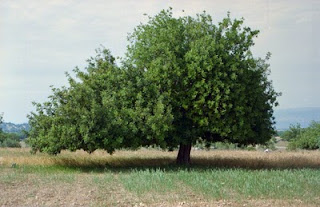
There's a Talmudic parable about the carob tree. According to the rabbis (who were clearly not botanists), it takes seventy years for a carob to flower. When asked then why he was planting a carob tree when he'd never live to see its fruit, the farmer in the story says that he enjoys the fruit of a carob tree planted for him by his grandfather; similarly he is planting a carob for his grandchildren.
Planting a carob is not one of those highly touted "random acts of kindness." It's rather a deferred one - a blessing that will blossom only later, with no benefit accruing to yourself.
So what are the carob trees that were planted for us? The ocean voyages of long-gone grandparents looking for a better life, if not for themselves, then for those who would come after? The love of learning implanted in our psyches 70 generations back? The desire for community felt by Jews of central Sonoma County twenty-five years ago, many of whom are no longer part of this congregation or this county but whose imprints we still feel? Or the clubhouse built by the dedicated women of the Cotati Ladies' Improvement Club, none of whom we knew and none of whom could have foreseen that this home built to house their vision of a better world would someday nourish this holy community?
And what are the carob trees that we are planting now for our future generations? When we make decisions for our children, are we remembering to think of the future adults they will be and what they will pass on to their children? When we make decisions for our synagogue and our community, are they just about this year's programs and improvements, or are we also setting the stage for future waves that we might never know? When we think about our relationship with the Earth, do we keep in mind our posterity (if not our biological grandchildren, then our spiritual heirs, once or twice removed)?
I always try to notice the carob trees that feed me and shade me. The seeds planted in my youth by parents, teachers, great- grandparents and my groovy lakefront aunties. Some of those seeds have, thanks to this community, had a chance at last to bear some fruit, chewy and unripe though it still might be. I'm grateful for those who planted the seeds without knowing the outcome. And I will try to follow in their footsteps, planting my carob, sowing seeds without certainty, but with certain hope.
And as we begin to move toward the High Holy Day season I leave you to ask yourself: "what are the seeds I am planting?"

There's a Talmudic parable about the carob tree. According to the rabbis (who were clearly not botanists), it takes seventy years for a carob to flower. When asked then why he was planting a carob tree when he'd never live to see its fruit, the farmer in the story says that he enjoys the fruit of a carob tree planted for him by his grandfather; similarly he is planting a carob for his grandchildren.
Planting a carob is not one of those highly touted "random acts of kindness." It's rather a deferred one - a blessing that will blossom only later, with no benefit accruing to yourself.
So what are the carob trees that were planted for us? The ocean voyages of long-gone grandparents looking for a better life, if not for themselves, then for those who would come after? The love of learning implanted in our psyches 70 generations back? The desire for community felt by Jews of central Sonoma County twenty-five years ago, many of whom are no longer part of this congregation or this county but whose imprints we still feel? Or the clubhouse built by the dedicated women of the Cotati Ladies' Improvement Club, none of whom we knew and none of whom could have foreseen that this home built to house their vision of a better world would someday nourish this holy community?
And what are the carob trees that we are planting now for our future generations? When we make decisions for our children, are we remembering to think of the future adults they will be and what they will pass on to their children? When we make decisions for our synagogue and our community, are they just about this year's programs and improvements, or are we also setting the stage for future waves that we might never know? When we think about our relationship with the Earth, do we keep in mind our posterity (if not our biological grandchildren, then our spiritual heirs, once or twice removed)?
I always try to notice the carob trees that feed me and shade me. The seeds planted in my youth by parents, teachers, great- grandparents and my groovy lakefront aunties. Some of those seeds have, thanks to this community, had a chance at last to bear some fruit, chewy and unripe though it still might be. I'm grateful for those who planted the seeds without knowing the outcome. And I will try to follow in their footsteps, planting my carob, sowing seeds without certainty, but with certain hope.
And as we begin to move toward the High Holy Day season I leave you to ask yourself: "what are the seeds I am planting?"
Saturday, June 19, 2010
Parashat Chukat: Talking to the Rock
[For Congregation Ner Shalom, June 18, 2010]

We’ll start with a quick confession. I talk to trees. I talk to plants. Every day on my way up and down the mountain I certainly greet the cows with a “ladies.” I talk to the cats, but that’s not considered odd. I talk to the goats next door but no one sees me. I might talk to the clouds from time to time, or to a particularly breathtaking landscape. Any object of wonder that takes me by surprise gets a “well, hello there.”

We’ll start with a quick confession. I talk to trees. I talk to plants. Every day on my way up and down the mountain I certainly greet the cows with a “ladies.” I talk to the cats, but that’s not considered odd. I talk to the goats next door but no one sees me. I might talk to the clouds from time to time, or to a particularly breathtaking landscape. Any object of wonder that takes me by surprise gets a “well, hello there.”
This week we read Parashat Chukat, in which Moses and Aaron are instructed to speak to a rock, and they fail.
But that’s not the first thing to happen in the parashah. We start instead by learning about the ritual of the red heifer – a rite of purification after contact with a dead body.
From there we go on to experience a most painful death. Miriam dies in the wilderness. This is now near the end of the Israelites’ 40 years in the desert. She was no longer a young woman. But her death stings and her absence is immediately felt. In the very next verse the people are thirsty. Quenching thirst was, as you recall, Miriam’s special talent. As Rabbi Shefa Gold says in her Torah Journeys book, “Miriam had a way with water.” There was a magical well that would follow her like a familiar and open at her command or at her request. The mouth of this mysterious well was created on the eve of the seventh day of creation for the sole purpose of slaking the thirst of the Israelites many generations or maybe eons later, or so goes the midrash. Whether there was a magic well, or whether she had a sharp divining skill, or whether Miriam satisfied a kind of spiritual thirst that the people mistook for physical, we don’t know. But when she dies, the people are immediately parched.
The people, in their desperate thirst, rise up against Moses and Aaron, once again asking why they were taken out of Egypt to die in a barren wilderness, the same complaint that has dogged Moses’ footsteps since the Red Sea closed behind them, barring the way to second thoughts. Moses and Aaron go to the tent of meeting and fall on their faces. God makes Gods presence known and tells them to go speak to a stone – an enormous, fixed boulder, a cliff, in full view of the people – and it would give them water.
Moses takes his staff and assembles the people. “Listen up, you rebels,” came Moses’ challenge, “shall we draw water out of the rock for you?” And he strikes the stone, not once, but twice, until water gushes forth, a mighty flow capable of sating all the people.
The next thing that happens surprises us. God is angered at Moses and Aaron. Lo-he’emantem bi l’haqdisheni l’eyney B’nei Yisrael. “You did not believe in Me,” God says, “enough to sanctify Me in the eyes of the Israelites.” You did not believe in Me. God announces a punishment: Moses and Aaron will not lead the people to the Promised Land but will, like the rest of their generation, die in the wilderness.
What was the source of God’s anger? Wasn’t the end result what God wanted – that the people should drink? Rashi says it is because of Moses’ words to the people. Ramban says it is because he struck the stone.
The Chasidic master, Rebbe Levi Yitzchak of Berditchev, says that those two views are not different views at all, since Moses’ speech to the people led inexorably to Moses’ striking the rock. According to Reb Levi Yitzchak, the world was created for the People of Israel. And when the People of Israel become mindful of their connection to the divine, become re-aware that their life force comes from the holy throne, then nature will provide for them of its own accord.
The idea that Creation came into being for our benefit is a central belief in the Chasidic world. Of course we see the world differently. Not created for the People of Israel. Not created for People at all. Still, we are the centers of our own existence, and we insist on living. So we struggle to find a balance between hubris and humility; between asserting our right to survive on the planet and the caution to mind our place. (We are reminded of the insight of the Chasidic rabbi Simcha Bunam, who said everyone should have a piece of paper in his right pocket saying, “For my sake the world was created” and a piece of paper in his left pocket saying, “I am but dust and ashes.”)
Levi Yitzchak describes two kinds of leadership in his analysis of the punishment God places on Moses and Aaron. Someone who is worthy of leadership will appeal to people’s highest selves. Such a leader will remind those she leads of their loftiness of spirit and the source of their lives in the divine. Her leadership will raise the people’s sights and the level of their actions. It will, in turn, inspire Creation itself to do what it was meant to do – to provide for us – of its own accord.
But when one leads with words of harshness or with shaming, one’s intended followers are not inspired, nor is Creation. The subjects of such a leader must be coerced. And so must nature itself.
For this reason, once Moses spoke harshly and shamingly to the people, his striking of the stone was inevitable, because the stone would not be moved to give. But God didn’t tell Moses to speak to the people or to strike the stone. God told Moses to speak to the stone. Had Moses said to it, "for this you were created, to give water to a parched people in a time of need, a holy people whose source is the same as yours," the stone would have gushed water in a great fountain. But Moses bypassed this opportunity, and the stone gave only because it was coerced.
And so perhaps God’s anger was not that Moshe had disobeyed an order, but because the whole event was meant to be theatre – a demonstration to the people that everything comes from God’s power. That speaking and listening to all of Creation will result in your receiving what you need. (As the other kind of stones, the rolling kind, might have said: “You can’t always get what you want, but if you talk to the rock, you’re gonna find you’ll get what you need.”)
But Moses messed up the theatre. He instead taught that nature may be compelled, bent to our will. And that remains how our culture views the world around us. If you strike the rock hard enough or drill it deep enough, something will gush forth, even if it’s not what or when or how you wanted it.
So perhaps there is a lesson here about who we are in the world and how we might relate to Creation around us. But I think there is something else here also, something hinted at by the fact that the story immediately follows the description of the purification ritual after a death. There is something here about grief and about the return to the flow of life.
The Children of Israel in the story were thirsty not only from the dryness of the desert, but from the loss of their prophet Miriam and all she had come to mean to them. And Moses and Aaron, burdened with leadership, are also in a state of deep grief that may have undermined their natural leadership instincts and destabilized their sense of their place in Creation. Doesn’t grief do that?
Deeply afflicted, having lost in Miriam a prophet, a counselor and a sister, Moses and Aaron were quick to anger. They acted out. I understand this. I remember once, eight months after my father’s death, bursting into anger uncontrollably over some trifle, or maybe not a trifle, I can’t even remember what it was. Anger until I was crying. My grief had destabilized me.
Or maybe it wasn’t exactly blind anger that Moses and Aaron were driven to. Maybe they felt powerless in the wake of Miriam’s loss. Their words: “Listen, rebels, shall we draw water from the rock?” is ambiguous. The word “rebels” is spelled in Biblical Hebrew identically to the name “Miriam.” By re-voweling it, the sentence could just as easily mean, “Listen, are we Miriam that we can draw water from the rock?” They feel their inability. They feel it so deeply that they don’t even recognize that God’s instruction, “talk to the rock” might specifically be a revelation of Miriam's method for drawing water!*
Either way, they are obviously hobbled by grief. So shouldn’t we – shouldn’t God – cut Moses and Aaron some slack?
Maybe not, if the point of the whole exercise was to teach something about responding to grief and loss. After all, God could have had already had the tap running when the Children of Israel arrived. The unnoticed miracle of pre-running water! But instead, the scene is set so that some sort of demonstration has to happen. But instead of a demonstration about water, it is a lesson about grief.
Because grief is a rock. And grief is a deep thirst.
When we grieve, we are dry as stone, heavy, immobile. Maybe God’s intended lesson here was that you can’t overcome grief by hacking at it, by coercing it, by overpowering it. All we can do is talk to it. Hello grief, I know you come from the same holy source as life itself. You are the flipside of my joys. When I look at you, my grief, I see myself. I see who I have become, who I wanted to be, and maybe who I may yet become.
You talk to grief. And then you wait, in a slow plodding of time that feels truly geological. Until the water begins to trickle – when even a trickle had been inconceivable – and then flow and then gush. Your grief was created for you. To hold your sadness and your longing, to mirror your love, and ultimately to become a source of holiness, a source of sweetness to rival even the salt of your tears.
May we all learn to speak to the stone. To speak to nature around us. And speak to our own natures. May we trust that speech. So that all of Creation – every rock, tree, creature and every one of us – may spout forth with holiness.
* I am indebted to Ari Kamiti for this breathtaking and compassionate insight.
Saturday, June 5, 2010
Shlach Lecha: On Grasshoppers, Giants & Flotillas
[Drash for Congregation Ner Shalom, June 4, 2010.]
 I was in Boston early this week for a Bar Mitzvah – the son of my oldest, dearest friend. It was a Monday morning event (which can happen in communities where Torah is read also on weekdays).
I was somewhat of an honored guest it seemed, so they asked me to participate in the service. Being nothing like shy, I of course said yes, offering to sing or improvise something – the kind of thing I would normally do here in our community. But the night before the Bar Mitzvah, my friends told me that they’d slated me in the program to read the Prayer for the State of Israel. It was already in print.
I took a deep breath and thanked them for the honor. Now if I were being asked to create a prayer for the State of Israel, this would have been an easy request. Israel is always in my prayers. But I was being asked to read the words in the Conservative siddur, which step slightly beyond a plea for safety, survival and peace:
“Strengthen the hands of the defenders of our Holy Land and crown them in victory.” Of course, I could understand nitzachon, “victory,” in metaphoric terms, but the prayer doesn't seem to. Victory here is an unqualified absolute, giving the prayer an undeniable military flavor that does not easily roll off my tongue. Nonetheless, this was my assignment in a ritual not of my making.
Monday morning I woke up to dress for the Bar Mitzvah and learned that during the night Israeli soldiers had boarded a ship headed for Gaza, in international waters. A peace convoy, some would say. A provocation, others would say. Predictably, it had all gone terribly, terribly wrong, leaving nine civilian activists known dead and Israel once again as the focus of the world’s scrutiny.
I tried to collect myself. I was filled with sadness and anger and a feeling of betrayal. How can the Israel that I love – and I do love it even when I am outraged by its actions – let this happen? My anger is understandable to most of you in this room; we are generally progressives in this community, and often critical of Israeli policy. But the internet war had already begun. YouTube videos of uninterpretable scenes were being posted, and emails started arriving in my inbox telling me to wait for all the evidence to be in (which was reasonable) and urging me to defend Israel against those who would slander it – and that “slanderer” part felt, as it always does at such moments, aimed at me.
I tore myself from the news and, heavy hearted, went to the Bar Mitzvah. I sat down in shul and listened to my friend’s son’s fluent chanting of this week’s parashah, Shlach Lecha.
In Shlach Lecha the Israelites are preparing for the conquest of what will become the Land of Israel. God tells Moshe to send margalim – “scouts” - one from each tribe, up into the land to determine if its inhabitants are strong or weak, good or bad, if the cities are open or fortified, if the soil is rich or poor.
The margalim return, famously reporting that the land is flowing with milk and honey. Two of the scouts, Caleb and Joshua, are confident about their military prospects. Caleb, says, “Let us go up and gain possession of the land, for surely we can overcome it.” But the other scouts dissent. “We cannot attack, for the people are stronger than we. The country devours its settlers. The people are giants – and we looked like grasshoppers to ourselves, and so must we have looked to them.”
These words spread through the camp and the Israelites lose their nerve. They beg to be brought back to Egypt. God is angered and punishes the people by declaring that the older generation would die in the wilderness. Of all the people assembled, only Caleb and Joshua, with their great confidence in the strength of Israel would be allowed to enter the land.
I sat and listened to the parashah, thinking how we, all these years later, have possession of that very same real estate. So which are we now, I wondered, grasshoppers or giants?
It seemed to me that as possessors and not the dispossessed, it would be easy to cast us in the role of giants. Certainly much of the world paints Israel that way. But I’m beginning to think that after two thousand years of relentless conditioning, however we might be perceived by others, we still don’t know how not to be grasshoppers.
To a grasshopper, every encounter with the greater world involves the risk of being crushed underfoot. And hasn’t this been the Jewish experience over the last two and a half millennia? The risk of annihilation at every turn? We tell our tales of exile and pogroms and close escapes and failed escapes. We pray for peace; we pray to God to confound the counsels of those who would do us harm.
But nothing in our tradition has taught us how to hold power. How to be giants. Instead, we’re left to be giants who think like grasshoppers, or grasshoppers who have grown to gigantic proportions. And it is that constant, deep fear of being crushed underfoot that has informed and, arguably, poisoned so much of our policy in Israel.
I should footnote here that I say “our policy,” not “their policy.” I think it’s important both to say and to let ourselves actually feel the “we.” It is important that even when we oppose Israeli governmental policy – especially when we oppose Israeli governmental policy – we reaffirm our connection as Jews. It is what makes our voice of opposition powerful and meaningful; it is also how we support Israelis who are working for peace. Our inclusion is what we were promised by the Zionist dream when we were young. We were promised that this would be a joint venture. We should not now cede that promise only to those who agree with Israeli military actions. In other words, more than I want to disown Netanyahu, I want Netanyahu to be stuck with the likes of us.
I also need to offer the obvious but very real disclaimers. I do not live in Israel, although I have in the past and many of my loved ones do now. I’ve never had to fear suicide bombers on a daily basis and I’ve not experienced the relief of knowing that a wall currently stands between me and that particular danger. I’ve never had to dodge the bullets; nor have I been required to fire them. I am not a politician or an expert. I cannot speak from the depth of Israeli experience. But that doesn’t mean I have nothing to say.
I also don’t know what happened on that ship. Time will (or won’t) tell who did what to whom first. But I do know that it was a no-win situation, as long as we were in a position where a humanitarian action against us was necessary. Yes, the flotilla was at least as much or more a public relations mission as it was an aid mission, as some people hasten to point out. But so what? Sit-ins at lunch counters in the 1960s south were public relations stunts also. That is how public opinion is swayed, it is how one appeals to the hearts and consciences of the world.
Using deadly force against a public relations mission is the sign, to me, of government by grasshopper. To Israel this flotilla looked like another shoe about to crush us. Everything looks like a shoe about to crush us. Give a grasshopper a gun, and what will it do? It will shoot. If not today, then tomorrow.
A giant, on the other hand, well, giants are perhaps underestimated. A giant who understands and trusts its own power can afford a far greater range of responses to seeming threats. The use of force would only be one possible response among many.
In an Op Ed column on Tuesday, Israeli author and peace activist Amos Oz wrote, “[D]uring Israel’s early years, prime ministers like David Ben-Gurion and Levi Eshkol knew very well that force has its limits and were careful to use it only as a last resort. But ever since the Six-Day War in 1967, Israel has been fixated on military force. To a man with a big hammer, says the proverb, every problem looks like a nail.”
Defenders of Israel’s actions this week point to the rise of Hamas in Gaza. This is true and I do not suggest that Hamas is not a danger. But we are also smart enough to know that those whom you besiege do not become your friends. When you starve a people you cultivate a population with nothing to lose. On the other hand, in a prosperous, flourishing Palestine, how sexy would Hamas actually be?
Defenders of Israel’s actions also point to the fact that Gaza has two borders – one with Israel and one with Egypt. And Egypt was not opening its border either. In other words, it is unfair to hold Israel to a higher standard than other nations. Perhaps that’s right. The world does not have the right to hold Israel to a higher standard. But we do. Jews do. We are not accountable for Egypt. But for Israel we are. Again, it’s part of the agreement.
So I seem to be mostly talking about our right, as Jews, as people who want Israel to survive, to dissent. Because that no longer feels obvious. But I’d intended to talk about grasshoppers.
And so, young grasshoppers, courage is required. Not the courage to use force. But the courage not to. The courage to dream up other paths and to actually risk taking them. The courage to engage in peacemaking – real, non-grudging peacemaking – and earn back the world’s trust. The courage to help our neighbors and former enemies prosper. Maybe we can’t put down the guns entirely at this moment. But surely we can move our fingers off the triggers, even if just a little.
It will take more courage not to use force than it does to use it. It will take greatness. And I still believe we are capable of greatness; of the greatness of giants. We are already giants in military might. Let us soon be giants in wisdom and compassion and vision and patience.
You may wonder what I did about reciting the prayer for the State of Israel on Monday. I thought of some language I could add, like I might naturally do here at Ner Shalom. I was asked to deliver it in Hebrew so I thought, well, who will notice? I got up on the bimah and began the prayer. But this was a community where everyone prays in Hebrew. With my first word they joined me and recited with me, every word. I was walked down the path of this text, accompanied on all sides, with no chance for a detour. Which is exactly how it should have been at that moment.
But now I’d like to return the Prayer for the State of Israel, not how it was written in that siddur but how I wish it were written.

I was somewhat of an honored guest it seemed, so they asked me to participate in the service. Being nothing like shy, I of course said yes, offering to sing or improvise something – the kind of thing I would normally do here in our community. But the night before the Bar Mitzvah, my friends told me that they’d slated me in the program to read the Prayer for the State of Israel. It was already in print.
I took a deep breath and thanked them for the honor. Now if I were being asked to create a prayer for the State of Israel, this would have been an easy request. Israel is always in my prayers. But I was being asked to read the words in the Conservative siddur, which step slightly beyond a plea for safety, survival and peace:
Chazek et y’dey m’giney eretz kodshenu
va’ateret nitzachon t’atrem…
“Strengthen the hands of the defenders of our Holy Land and crown them in victory.” Of course, I could understand nitzachon, “victory,” in metaphoric terms, but the prayer doesn't seem to. Victory here is an unqualified absolute, giving the prayer an undeniable military flavor that does not easily roll off my tongue. Nonetheless, this was my assignment in a ritual not of my making.
Monday morning I woke up to dress for the Bar Mitzvah and learned that during the night Israeli soldiers had boarded a ship headed for Gaza, in international waters. A peace convoy, some would say. A provocation, others would say. Predictably, it had all gone terribly, terribly wrong, leaving nine civilian activists known dead and Israel once again as the focus of the world’s scrutiny.
I tried to collect myself. I was filled with sadness and anger and a feeling of betrayal. How can the Israel that I love – and I do love it even when I am outraged by its actions – let this happen? My anger is understandable to most of you in this room; we are generally progressives in this community, and often critical of Israeli policy. But the internet war had already begun. YouTube videos of uninterpretable scenes were being posted, and emails started arriving in my inbox telling me to wait for all the evidence to be in (which was reasonable) and urging me to defend Israel against those who would slander it – and that “slanderer” part felt, as it always does at such moments, aimed at me.
I tore myself from the news and, heavy hearted, went to the Bar Mitzvah. I sat down in shul and listened to my friend’s son’s fluent chanting of this week’s parashah, Shlach Lecha.
In Shlach Lecha the Israelites are preparing for the conquest of what will become the Land of Israel. God tells Moshe to send margalim – “scouts” - one from each tribe, up into the land to determine if its inhabitants are strong or weak, good or bad, if the cities are open or fortified, if the soil is rich or poor.
The margalim return, famously reporting that the land is flowing with milk and honey. Two of the scouts, Caleb and Joshua, are confident about their military prospects. Caleb, says, “Let us go up and gain possession of the land, for surely we can overcome it.” But the other scouts dissent. “We cannot attack, for the people are stronger than we. The country devours its settlers. The people are giants – and we looked like grasshoppers to ourselves, and so must we have looked to them.”
These words spread through the camp and the Israelites lose their nerve. They beg to be brought back to Egypt. God is angered and punishes the people by declaring that the older generation would die in the wilderness. Of all the people assembled, only Caleb and Joshua, with their great confidence in the strength of Israel would be allowed to enter the land.
I sat and listened to the parashah, thinking how we, all these years later, have possession of that very same real estate. So which are we now, I wondered, grasshoppers or giants?
It seemed to me that as possessors and not the dispossessed, it would be easy to cast us in the role of giants. Certainly much of the world paints Israel that way. But I’m beginning to think that after two thousand years of relentless conditioning, however we might be perceived by others, we still don’t know how not to be grasshoppers.
To a grasshopper, every encounter with the greater world involves the risk of being crushed underfoot. And hasn’t this been the Jewish experience over the last two and a half millennia? The risk of annihilation at every turn? We tell our tales of exile and pogroms and close escapes and failed escapes. We pray for peace; we pray to God to confound the counsels of those who would do us harm.
But nothing in our tradition has taught us how to hold power. How to be giants. Instead, we’re left to be giants who think like grasshoppers, or grasshoppers who have grown to gigantic proportions. And it is that constant, deep fear of being crushed underfoot that has informed and, arguably, poisoned so much of our policy in Israel.
I should footnote here that I say “our policy,” not “their policy.” I think it’s important both to say and to let ourselves actually feel the “we.” It is important that even when we oppose Israeli governmental policy – especially when we oppose Israeli governmental policy – we reaffirm our connection as Jews. It is what makes our voice of opposition powerful and meaningful; it is also how we support Israelis who are working for peace. Our inclusion is what we were promised by the Zionist dream when we were young. We were promised that this would be a joint venture. We should not now cede that promise only to those who agree with Israeli military actions. In other words, more than I want to disown Netanyahu, I want Netanyahu to be stuck with the likes of us.
I also need to offer the obvious but very real disclaimers. I do not live in Israel, although I have in the past and many of my loved ones do now. I’ve never had to fear suicide bombers on a daily basis and I’ve not experienced the relief of knowing that a wall currently stands between me and that particular danger. I’ve never had to dodge the bullets; nor have I been required to fire them. I am not a politician or an expert. I cannot speak from the depth of Israeli experience. But that doesn’t mean I have nothing to say.
I also don’t know what happened on that ship. Time will (or won’t) tell who did what to whom first. But I do know that it was a no-win situation, as long as we were in a position where a humanitarian action against us was necessary. Yes, the flotilla was at least as much or more a public relations mission as it was an aid mission, as some people hasten to point out. But so what? Sit-ins at lunch counters in the 1960s south were public relations stunts also. That is how public opinion is swayed, it is how one appeals to the hearts and consciences of the world.
Using deadly force against a public relations mission is the sign, to me, of government by grasshopper. To Israel this flotilla looked like another shoe about to crush us. Everything looks like a shoe about to crush us. Give a grasshopper a gun, and what will it do? It will shoot. If not today, then tomorrow.
A giant, on the other hand, well, giants are perhaps underestimated. A giant who understands and trusts its own power can afford a far greater range of responses to seeming threats. The use of force would only be one possible response among many.
In an Op Ed column on Tuesday, Israeli author and peace activist Amos Oz wrote, “[D]uring Israel’s early years, prime ministers like David Ben-Gurion and Levi Eshkol knew very well that force has its limits and were careful to use it only as a last resort. But ever since the Six-Day War in 1967, Israel has been fixated on military force. To a man with a big hammer, says the proverb, every problem looks like a nail.”
Defenders of Israel’s actions this week point to the rise of Hamas in Gaza. This is true and I do not suggest that Hamas is not a danger. But we are also smart enough to know that those whom you besiege do not become your friends. When you starve a people you cultivate a population with nothing to lose. On the other hand, in a prosperous, flourishing Palestine, how sexy would Hamas actually be?
Defenders of Israel’s actions also point to the fact that Gaza has two borders – one with Israel and one with Egypt. And Egypt was not opening its border either. In other words, it is unfair to hold Israel to a higher standard than other nations. Perhaps that’s right. The world does not have the right to hold Israel to a higher standard. But we do. Jews do. We are not accountable for Egypt. But for Israel we are. Again, it’s part of the agreement.
So I seem to be mostly talking about our right, as Jews, as people who want Israel to survive, to dissent. Because that no longer feels obvious. But I’d intended to talk about grasshoppers.
And so, young grasshoppers, courage is required. Not the courage to use force. But the courage not to. The courage to dream up other paths and to actually risk taking them. The courage to engage in peacemaking – real, non-grudging peacemaking – and earn back the world’s trust. The courage to help our neighbors and former enemies prosper. Maybe we can’t put down the guns entirely at this moment. But surely we can move our fingers off the triggers, even if just a little.
It will take more courage not to use force than it does to use it. It will take greatness. And I still believe we are capable of greatness; of the greatness of giants. We are already giants in military might. Let us soon be giants in wisdom and compassion and vision and patience.
You may wonder what I did about reciting the prayer for the State of Israel on Monday. I thought of some language I could add, like I might naturally do here at Ner Shalom. I was asked to deliver it in Hebrew so I thought, well, who will notice? I got up on the bimah and began the prayer. But this was a community where everyone prays in Hebrew. With my first word they joined me and recited with me, every word. I was walked down the path of this text, accompanied on all sides, with no chance for a detour. Which is exactly how it should have been at that moment.
But now I’d like to return the Prayer for the State of Israel, not how it was written in that siddur but how I wish it were written.
Avinu Shebashamayim,
Rock and Redeemer of the People Israel;
Rock and Redeemer of the People Israel;
Bless the State of Israel.
Enrich it with Your love;
spread over it the shelter of Your peace.
spread over it the shelter of Your peace.
Guide its leaders and advisors
with Your light and Your truth.
with Your light and Your truth.
Help them with Your good counsel.
Strengthen our hearts and hands,
so that we may not be devoured by the land;
so that we may not be devoured by the land;
so that we may not be devoured by fear.
Crown us with courage
so that we may be giants of wisdom and compassion.
so that we may be giants of wisdom and compassion.
Bless us with vision, so that through us
and all who are touched by your spirit,
and all who are touched by your spirit,
there may be lasting peace and joy in the land
and throughout the world.
and throughout the world.
And let us say: Amen.
Saturday, May 8, 2010
Behar-Bechukotai: Of Oil Spills and Old Covenants
[Drash for Congregation Ner Shalom, May 7, 2010.]

 But owning our godliness in this respect also gives me hope. If by our actions we are God - for good and for ill - then we are the ones bound by the brit, bound by the covenant of the rainbow made after the flood. We signed onto an oath, not as the human parties, but as God's proxy. And so there is no loophole for us. No way to say "not me, not us." We have made a covenant with all life: "every living soul - the birds, the cattle and every beast of the earth." And so we are oath-bound to protect the air and the water, to protest exploitation of limited resources, to sing out for sustainability, to rethink, to remediate, to live more simply.
This Shabbat, it seems, is meant to be a Shabbat all about the Earth. We have a confluence of several factors that make me say that. First we have a double Torah portion this week - Behar and Bechukotai, both having to do with our responsibilities toward the Earth. The second item is that Sunday is Mother's Day, and don't we always say the Earth is our mother? And the third, well, I'll tell you about the third item later.
First, the Torah portions. These are the last two of the book of Leviticus. Behar lays out the rules of the shmitah year, the seventh year in which the fields must be left fallow. The text says:
The land must be given a rest period, a sabbath to God. For six years you may plant your fields, prune your vineyards, and harvest your crops, but the seventh year is a sabbath of sabbaths - shabbat shabbaton - for the land.
The land deserves a rest. This is remarkable. In the same way that we are granted the holiness of Shabbat every seventh day, the Earth is entitled to take its own sweet Shabbat every seventh year.
While modern commentators have made hay, as it were, of the view that leaving fields fallow is simply sound agricultural practice, nowhere does Torah say that this is the reason for the shmitah year. Instead, it is simply shabbat for the land. It is for the land's sake, not for ours. It is a year in which we may not exert mastery over it. And we, as a by-product, are forced to live a different kind of life. Less ambitious, slower perhaps, a year of some uncertainty, a year without extravagance. A pre-agricultural year, like in the days of Eden. A year where Earth is our companion, not our servant. A year in which we are reminded that the earth deserves -- well, the Earth simply deserves.
It's appealing to me that this portion falls on the eve of Mother's Day. Just a nice little modern coincidence, since we so enjoy articulating the metaphor of Earth as Mother. "Earth as mother" is, of course, an old metaphor, both widespread and apt. Gaia gave birth to us and we owe her the honor we owe our mothers.
Kabed it avicha v'et imecha -- "honor your father and your mother," says the Ten Commandments. "Love your Mother," says the bumper sticker.

But I wonder sometimes if the mother-child metaphor is problematic also. We are, after all, not a species that does so well with the mother-honoring business. Maybe if we were another kind of creature - say, the Pando tree of Utah - 47,000 aspen stems flourishing in seeming independence above ground, but growing from one root stock as one enormous and continuous organism. But no. Instead we belong to a species where children are born of their mothers, are nurtured by them, but then, if we're successful, are compelled to individuate. Differentiating from our parents is our genetic and cultural imperative. In fact we spend much of our adolescence pushing mom away, and sometimes spend the rest of our lives going around and around that internal conflict. No wonder Torah has to command us to honor our parents. If it came naturally, who'd need a commandment?
Maybe this flawed mother-child metaphor in fact describes our relationship with the Earth accurately. She gave us life and yet we feel compelled to push her away. We differentiate. Like eye-rolling teenagers, we don't see the Earth as our mother, but merely as our address.
All of this bubbles up for me this week as we witness the devastation that has been unleashed on the Gulf Coast and take stock of the newest batch of creatures and habitats that we've handed over to oblivion. How could this happen? Certainly not for lack of knowledge of the risks of offshore drilling or any of the other aggressive environment-changing activities carried on in our name.
Perhaps the answer is connected with the third element of our confluence of factors this weekend. This coming Monday, the 27th of Iyar, is the date Torah gives for when Noah and his family and all the animals were finally able to leave the ark. And on that day, God made a brit - a covenant that never again would God destroy all life because of the evil acts of humans. And the rainbow appears as God's signature on the dotted line.
But despite God's promise, aren't we moving toward destruction?Aren't we slowly (or not so slowly) creating a desolation in which, using the language of Bechukotai, the second of this week's twin portions, the skies will be like iron and the land like brass? How can this be happening?
There is a clue, I think, in midrash surrounding the Noah story. Something about human nature. I was visiting a cousin this week who asked me a kind of fun-fact Bible question. He asked me why the people didn't believe Noah when he told them that it would rain until they were destroyed by flood. (After all, according to our sages, Noah took 120 years to build the ark, giving the people around him plenty of time to repent. But they scoffed at him.) My cousin answered the question, saying it was because they had never seen rain, since rain isn't mentioned in Torah before this point. And so they had no reason to believe a cockamamie story about water falling from the sky. This is a revealing insight. We don't believe in danger that we haven't personally experienced.
We don't even need such an extreme reading of the Noah story to answer to my cousin's riddle. Perhaps they in fact knew rain as well as any of us does; they'd seen it all their lives. But they'd never seen rain kill. And so, once again, they had no reason to believe a dire warning that lay outside of their experience. And when the great rain started, it was undoubtedly just a drizzle.
Like the old chestnut about boiling the frog. If the water heats up slowly enough, the popular wisdom (although perhaps not the science) goes, the frog doesn't react to the change of temperature and doesn't act to save itself. And so with offshore drilling. So with climate change. We know a tremendous amount, both collectively and individually, about the changes taking place in the environment and the dangers they pose. But we, as a culture, don't react. It is gradual - too gradual to kick our adrenaline into gear. If it hasn't killed us yet, why suppose it will? When will we feel instinctively that we must act? And by that time, will we already be poached frog?
My teacher Rabbi David Seidenberg pointed out this week that although God promised not to destroy all life, God never said that we couldn't.
Our willingness to let life on Earth unravel is a function of disbelief; a function of the nearly imperceptible pace of climate change; a function of the brevity of our own lives; a function of our ardent and adolescent differentiation from Earth our Mother; and a function of our stubborn, lurking and unfounded belief that there is, somewhere out there, a God who will step in, father-like, and save us from ourselves.
I'm aware that I'm preaching to the choir. But maybe not, because if there is a choir, I'm not in it. I know all these things. I read newspapers. I care. But I don't really do. I have only been affected intellectually. Global warming has not touched my experience. If the price of Gulf of Mexico oysters goes up this year, I can tell you with certainty I will not notice. In the meantime, I have chosen to live in a location where there is no option of public transportation or bicycle transit. I've eliminated many of my own best ways to reduce my carbon footprint. So how do I change? Is there a Jewish understanding we can use to help us step up?
Perhaps there is something in our understanding of God and how God acts in this world. Here, in what the Kabbalists would call Malchut - the kingdom, the majesty, the physical reality in which we live and the only world we can ever really know, God acts, if God acts at all, through us. In Reconstructionist lingo we talk about locating God in our shared impulse to do justice. When we act out of our best impulses, there is God.
But we neglect to mention the flipside. What of our combined worst impulses? Greed, apathy, willing ignorance, closing our eyes to injustice. Alas, God is there too. Not the God who comforts and provides, but the angry God of Bechukotai - the one promising environmental desolation in exchange for our misdeeds. Or the angry God of the Noah story, willing to let human faults justify the destruction of all life.
This is a terrifying thought to me. That we, through our actions, bring about that angry, biblical God, that one that as modern Jews we try so hard to distance ourselves from. It's hard to accept the amount of destructive power we actually wield. To misquote Walt Kelly in his Pogo comic strip written for Earth Day 39 years ago, "We have met the vengeful God, and He is us."

We do not have a choice. We are oath-bound, covenant-bound to do this. We do not do it [merely] out of mother love, honor, or self-interest. We do it out of deep, uncompromising obligation.
And so whenever we have a decision to make that has an impact on this Earth, in our lives or our work or our community institutions, whenever we are deciding whether to speak out on an environmental issue or not, let us stop, take a deep breath, and say the traditional blessing that is recited upon seeing a rainbow:
ברוך אתה יי זוכר הברית
Baruch Atah Yah, zocher habrit.
Blessed are You, Yah, who remembers the Covenant.
And blessed may We be, that we may remember the Covenant.
And blessed will all Existence be when the Covenant is kept.
ברוך אתה יי זוכר הברית
Baruch Atah Yah, zocher habrit.
Thursday, April 22, 2010
World Word Cloud

This is a doodley graphic representation of my Erev Rosh Hashanah drash created through the very clever program, Wordle. If this graphic makes you want to review the drash itself, you can just click here.
Tuesday, April 13, 2010
The Immensity of Absence
Invocation for the Sonoma County
Community-wide Yom HaShoah Commemoration
April 11, 2010
I'm honored and humbled to be asked to offer the invocation for today's commemoration. I am myself from a family of mameshdikeh Yankees: some of my forebears on this soil as early as the 1850s, the last straggler here by 1905. So that I stand here with an unprecedented century of safety behind me.
There were, of course, people in my family lost in the Shoah. But research was required to find their names.
And so I sometimes feel unequal to the task, when the task is to remember. How shall I remember? What shall I remember? How do I conjure up for myself a depth of pain that some in this room could not possibly conjure away, even if they wanted to?
The answer for me and many of my generation is, I think, to learn to see the invisible. I travelled to Poland three years ago. I was prepared to see the camps, and I was moved when I saw them. But weighing much more heavily on me, and staying with me even to this moment, was the immensity of what I didn't see.
Like looking at a picture where your eye suddenly sees the negative space jump to the front, we must train ourselves to appreciate what should be - but is not - there.
The actions never completed and dreams never realized.
The prayers never offered.
The poems left unpenned and the symphonies uncomposed.
The ideas not sparked and inventions never imagined.
The eyes that didn't meet and romances that didn't blossom.
The generations not born.
The cousins we should have had.
Seven decades of challahs not baked for Shabbos.
Uncountable tzedakah not given.
Old age never reached.
Peaceful deaths denied and honorable burials not granted.
The trivial moments that never even had the opportunity to be taken for granted.
This is an immensity of absence. As Jews, as citizens of the 21st Century, we live in it every day.
It is an emptiness the size of Europe.
So how do we not despair?
We blossom anew even in the midst of this desert.
We live. We dream.
We pen poems and compose symphonies.
Meet eyes, hold hands, make love.
We bake and we build.
We act justly.
We honor lost lives by living our own. With ferocity. With gusto.
We feel the sap coursing through us and, without guilt, we open our petals to the sky.
So that our lives are memory.
So that our lives are a tikkun.
So that we may be worthy to be alive.
We live, and through our lives, through our love, through our creativity and our compassion, we remember.
And we make sure that that memory becomes - for us, for others, and for this entire beautiful, terrible, undeserving and desperately needy world - a true blessing.
Ken y'hi ratzon. May it be so.
Community-wide Yom HaShoah Commemoration
April 11, 2010
I'm honored and humbled to be asked to offer the invocation for today's commemoration. I am myself from a family of mameshdikeh Yankees: some of my forebears on this soil as early as the 1850s, the last straggler here by 1905. So that I stand here with an unprecedented century of safety behind me.
There were, of course, people in my family lost in the Shoah. But research was required to find their names.
And so I sometimes feel unequal to the task, when the task is to remember. How shall I remember? What shall I remember? How do I conjure up for myself a depth of pain that some in this room could not possibly conjure away, even if they wanted to?
The answer for me and many of my generation is, I think, to learn to see the invisible. I travelled to Poland three years ago. I was prepared to see the camps, and I was moved when I saw them. But weighing much more heavily on me, and staying with me even to this moment, was the immensity of what I didn't see.
Like looking at a picture where your eye suddenly sees the negative space jump to the front, we must train ourselves to appreciate what should be - but is not - there.
The actions never completed and dreams never realized.
The prayers never offered.
The poems left unpenned and the symphonies uncomposed.
The ideas not sparked and inventions never imagined.
The eyes that didn't meet and romances that didn't blossom.
The generations not born.
The cousins we should have had.
Seven decades of challahs not baked for Shabbos.
Uncountable tzedakah not given.
Old age never reached.
Peaceful deaths denied and honorable burials not granted.
The trivial moments that never even had the opportunity to be taken for granted.
This is an immensity of absence. As Jews, as citizens of the 21st Century, we live in it every day.
It is an emptiness the size of Europe.
So how do we not despair?
We blossom anew even in the midst of this desert.
We live. We dream.
We pen poems and compose symphonies.
Meet eyes, hold hands, make love.
We bake and we build.
We act justly.
We honor lost lives by living our own. With ferocity. With gusto.
We feel the sap coursing through us and, without guilt, we open our petals to the sky.
So that our lives are memory.
So that our lives are a tikkun.
So that we may be worthy to be alive.
We live, and through our lives, through our love, through our creativity and our compassion, we remember.
And we make sure that that memory becomes - for us, for others, and for this entire beautiful, terrible, undeserving and desperately needy world - a true blessing.
Ken y'hi ratzon. May it be so.
Subscribe to:
Posts (Atom)